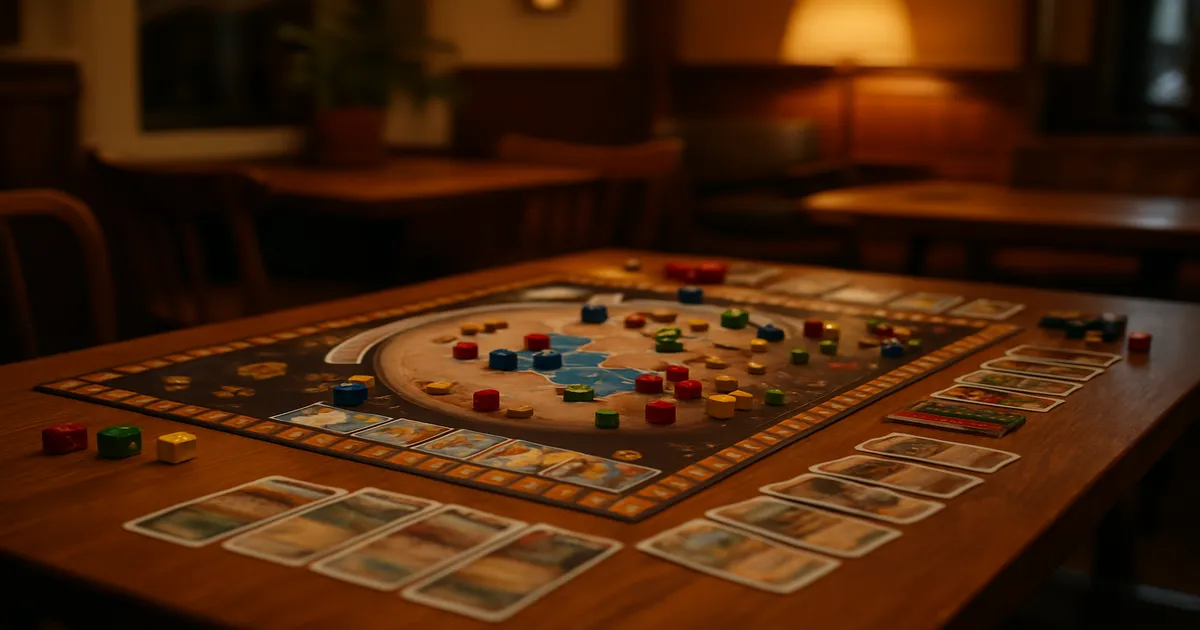

Quick Answer: Terraforming Mars is one of the best engine-building board games ever made — a meaty, card-driven strategy game where competing corporations race to make Mars habitable. It’s not for casual gamers or short sessions, but if you enjoy deep card combos and strategic planning, it absolutely earns its reputation.
This terraforming mars review board game keeps getting written because the game keeps earning it. Since Jacob Fryxelius designed it — published by FryxGames in 2016 — it’s sat in the BGG top 10 almost continuously, spawned half a dozen expansions, and converted thousands of players into lifelong engine-building fans. It’s also a game with real warts: thin player boards, inconsistent card art, and playtimes that can stretch past three hours at five players. So let’s actually talk about whether it belongs in your collection.
Terraforming Mars at a Glance
- Players: 1–5 (sweet spot is 3)
- Play time: 120–180 minutes (longer with new players or at 5)
- BGG weight: 3.26/5
- Price: ~$60–70 USD
- BGG ranking: Consistently top 5–10 of all time
Who it’s for: Players who love engine builders, card combos, and strategic depth that reveals itself over multiple plays. If you enjoy Race for the Galaxy, Wingspan, or Gaia Project, Terraforming Mars sits comfortably in that family — heavier than Wingspan, lighter than Gaia Project.
Who should skip it: Families looking for a 45-minute filler, or groups where someone actively hates reading card text. The rules aren’t brutal, but the card interactions take time to internalize.
How Terraforming Mars Works
The Core Goal
You and your fellow players are corporations in the 2400s, collectively — and competitively — making Mars livable. The game ends when three global parameters all hit their targets: temperature reaches +8°C, oxygen reaches 14%, and all nine ocean tiles are placed on the board. Whoever scored the most victory points wins, not whoever contributed the most to terraforming. That tension between shared goals and individual scoring is what makes the game sing.
Turn Structure
Each round (called a generation) runs through three phases:
- Card buying phase: Draw four cards, pay 3 MegaCredits each to keep the ones you want.
- Action phase: Players alternate taking one or two actions — playing cards, triggering card abilities, placing tiles, claiming milestones, converting resources — until everyone passes.
- Production phase: Collect resources based on your production tracks. All energy automatically converts to heat. Your Terraform Rating generates MegaCredits.
The Six Resources
Your player board tracks production and current stockpiles of six resources: MegaCredits (main currency), Steel (discounts building cards), Titanium (discounts space cards), Plants (convert to greenery tiles), Energy, and Heat (converts to temperature raises). The distinction between production and current resources trips up almost every new player — more on that below.
How Scoring Works
VP comes from multiple sources:
- Terraform Rating — 1 VP per TR point (you start at 20)
- Greenery tiles — 1 VP each
- City tiles — 1 VP per adjacent greenery at game end
- Milestones — 5 VP each (max 3 claimed per game)
- Awards — 5 VP for 1st place, 2 VP for 2nd (max 3 funded per game)
- Card VPs — Many cards award points based on specific conditions
Key Mechanics: What Makes Terraforming Mars Tick
Always Use Draft Mode
Use the card drafting variant. Always. In standard mode, you draw four random cards and buy from those. In draft mode, you pass cards around the table before buying — it dramatically reduces luck and adds real strategic decision-making. I’ve never met an experienced player who prefers standard mode.
Milestones and Awards: Don’t Sleep on Them
New players almost universally ignore milestones and awards in their first game, then spend their second game kicking themselves. Claiming a milestone is one action worth 5 VP — that’s exceptional value. The key insight: milestones reward being first to qualify, so claim them the moment you hit the threshold. Don’t wait. Awards reward whoever is leading when the game ends, so fund them when you have a comfortable lead, not when you’re hoping to catch up.
Tile Placement Matters More Than It Looks
The Mars board isn’t just a backdrop. Bonus spaces reward the first player to place there, cities score based on adjacent greeneries, and opponents can block valuable spots. Beginners treat tile placement as an afterthought; experienced players think about it constantly.
Your Corporation Choice Shapes Everything
Of all the decisions in Terraforming Mars, picking your corporation has the biggest impact on how your game plays out. Each one gives you different starting resources, production bonuses, and a unique ability that shapes your entire strategy. Getting this wrong — or not understanding what your corporation actually does — is the fastest way to have a frustrating game.
Components: An Honest Assessment
The components are genuinely the weakest part of the package. The player boards are thin cardboard that warps easily and doesn’t hold resource cubes reliably — this is the number one complaint, and it’s legitimate. The card stock is functional but not premium; sleeving is worth the investment.
For a $65 game, you’d expect more. Wingspan and Ark Nova both ship with noticeably better production quality at similar price points.
The art across the 208 cards is realistic and scientific — space photography vibes — but wildly inconsistent, since cards came from multiple artists. Some are stunning; some look rushed. That said, watching the Mars board slowly fill with tiles over three hours has its own slow-burn visual satisfaction that’s hard to replicate.
Upgrade Options
There’s a thriving upgrade market if the base components bother you. FryxGames released an official Big Box edition with 3D plastic player boards and proper storage — if you already know you love this game, it’s worth the premium. Third-party metal resource cube sets are also popular and genuinely improve the tactile experience.
Common Mistakes New Players Make
Rules Mistakes
- Skipping the card buying phase — You must actively pay 3 MC per card to keep it at the start of each generation. Easy to forget.
- Confusing production with resources — Your production track determines what you gain each round. Your resource cubes are what you spend. These are separate things.
- Missing energy-to-heat conversion — At the end of every generation, all your energy automatically becomes heat. Players forget this constantly.
- Not knowing plants and heat conversions are actions — Converting 8 plants into a greenery tile, or 8 heat into a temperature raise, are explicit actions you must choose. They don’t happen automatically.
Strategic Pitfalls
The biggest trap is hoarding cards. Buying a card feels like progress, but an unplayed card does nothing. Your hand is not your engine — your played cards are.
New players also undervalue Terraform Rating income. Every TR point earns you MegaCredits each production phase, so aggressive early terraforming often pulls you ahead on resources faster than it looks. And please, don’t ignore milestones. Five VP for one action is the best deal in the game.
Strategy Tips for Terraforming Mars
Corporation picks: Credicor and Phobolog are forgiving starting choices — intuitive enough to let beginners focus on learning the game. Ecoline, Mining Guild, and Inventrix are powerful but require enough card knowledge to exploit properly. Don’t hand a new player Ecoline in their first game.
Engine building: Prioritize production over one-time effects. A card that gives you 1 steel production every generation is almost always better than a card that gives you 5 steel once. Build your card plays around two or three tag types — Science, Space, and Building are common — because tag synergies create multiplicative value.
Tempo: Experienced players constantly track how many parameter steps remain. When the end is two or three generations away, your priorities shift hard toward VP — greeneries, cities, milestones, awards. Players who don’t make this pivot leave points on the table. Rushing the game end is also a legitimate strategy: if you’re ahead on TR and can push the last parameters to completion before opponents set up their engines, do it.
How Terraforming Mars Compares to Similar Games
vs. Ark Nova: This is the comparison everyone asks about. Ark Nova (1–4 players, 90–150 min, BGG weight 3.73/5) is tighter and more precisely balanced — many experienced players consider it the more refined design. Terraforming Mars has a much larger card pool, more expansions, and a shared-board narrative that Ark Nova doesn’t replicate. If you only buy one: Ark Nova for tighter strategy and better components; Terraforming Mars for more replayability and that “building a world together” feeling. Most serious strategy gamers eventually own both.
vs. Wingspan (1–5 players, 40–70 min, BGG weight 2.45/5): Lighter, faster, gorgeous components, gentler learning curve. A great gateway to engine builders, but it won’t scratch the same strategic itch.
vs. Gaia Project (1–4 players, 60–150 min, BGG weight 4.42/5): Goes harder in every direction — more complex faction asymmetry, deeper spatial strategy, steeper learning curve. If Terraforming Mars starts feeling too light, Gaia Project is the natural next step.
vs. Race for the Galaxy (2–4 players, 30–60 min, BGG weight 3.0/5): Similar card-combo engine-building in 45 minutes. The iconography is notoriously hard to learn, but once it clicks, it’s exceptional.
Expansions: Where to Go Next
Prelude (buy this first): Adds starting cards that accelerate your corporation’s early development, which meaningfully reduces the slow, resource-starved opening that frustrates new players. It’s inexpensive, integrates seamlessly, and makes the base game better in almost every way.
Hellas & Elysium: Two alternate Mars boards with different bonus spaces, milestones, and awards. Best expansion for replay value once the base board starts feeling familiar — same core game, genuinely different strategic landscape.
Venus Next / Colonies: Both expand the game’s scope without dramatically changing the feel. Venus Next adds a new global parameter; Colonies adds off-world mechanics.
Turmoil: The controversial one. Adds a political layer with global events that significantly increases complexity and play time. Veteran players tend to love it; newer players find it overwhelming. Hold off until your group is comfortable with the base game.
Ares Expedition: A fully standalone card game that captures the Terraforming Mars feel in 60–90 minutes. Strips out tile placement and streamlines resources — great for groups who love the card combos but struggle with the time commitment.
Frequently Asked Questions
Is Terraforming Mars worth buying for beginners?
It depends on the beginner. If they enjoy strategy games and don’t mind reading card text, yes — the core rules are learnable in one session and the depth reveals itself naturally. If they’re brand new to hobby games, Wingspan is a gentler starting point.
How long does a game of Terraforming Mars take?
Expect 2–3 hours for experienced players at 3–4 players. With new players or at 5, budget 3–4 hours. Adding Prelude trims the early game noticeably.
What’s the best expansion for Terraforming Mars?
Prelude, without much debate. It improves the base game immediately and costs less than most expansions. After that, Hellas & Elysium adds the most replay value for the price.
Is Terraforming Mars better than Ark Nova?
Neither is objectively better — they do different things. Ark Nova is more tightly balanced with better components. Terraforming Mars has a larger card pool, more expansions, and a shared board narrative that many players find uniquely satisfying.
Can you play Terraforming Mars solo?
Yes, and it’s genuinely good. The solo mode challenges you to complete all three global parameters within 14 generations — a tight, puzzle-like experience that’s excellent for learning card interactions. There’s also a solid digital version on Steam, iOS, and Android if you want to practice between sessions.