
Quick Answer: Quacks of Quedlinburg is one of the best gateway-to-mid-weight games of the past decade — a Kennerspiel des Jahres winner that combines bag-building and push-your-luck in a way that’s genuinely fun for almost everyone. It’s not a pure strategy game, but if you’re okay with luck playing a real role, it absolutely earns its spot on the shelf.
If you’ve landed here after scrolling through a “quacks of quedlinburg review reddit” thread, you’ve probably noticed the consensus is unusually positive. That’s not hype. Designed by Wolfgang Warsch and published by Schmidt Spiele, this game has held up across thousands of plays and multiple expansions, and the hobbyist community’s enthusiasm is well-earned.
What Reddit Really Thinks About Quacks of Quedlinburg
TL;DR Verdict
Quacks of Quedlinburg (2–4 players, 45–75 minutes, BGG weight 2.0/5) won the Kennerspiel des Jahres in 2018 — the German award for “connoisseur games” that sits between the family-weight Spiel des Jahres and heavier strategy titles. That award has an excellent track record, and this game is a prime example of why.
Pros:
- Simultaneous play means almost zero downtime
- Teaches in about 10 minutes, rewards dozens of plays
- The cloth bag drawing mechanic is genuinely tactile and tense
- Solid catch-up mechanic keeps everyone engaged
- High replayability from double-sided boards and fortune teller cards
Cons:
- Luck is a core feature, not a bug — luck-averse players will bounce off it hard
- Color-blind accessibility is a real concern
- The box insert is mediocre
Who Should Buy It (and Who Should Skip It)
Buy it if you are:
- A family with kids 10+ who want something meatier than Ticket to Ride
- A gateway gamer ready to step up from Catan
- Someone who loves the feeling of push-your-luck tension
- Looking for a game that plays well with 3–4 people without dragging
Skip it if you are:
- A heavy euro gamer who wants pure optimization with minimal randomness
- Someone who genuinely hates luck in games — this one won’t convert you
Game Overview: Theme, Mechanics, and How a Round Works
Theme and Setting
You’re a traveling charlatan — a quack doctor — at a medieval market in Quedlinburg, brewing potions from mysterious ingredients pulled from your bag. The theme is light and playful, and the whimsical art reinforces it perfectly. Nobody’s here for deep narrative immersion; the theme just gives a fun frame to hang the mechanics on.
Core Mechanics: Bag Building Meets Push-Your-Luck
Bag building works like deck building: you start with a basic set of chips and buy better ones over time, gradually improving your engine. Push-your-luck is the tension of deciding when to stop drawing before something goes wrong. Quacks combines both, and that combination is the magic trick — you’re building the very bag that’s going to tempt you into disaster.
How a Round Works
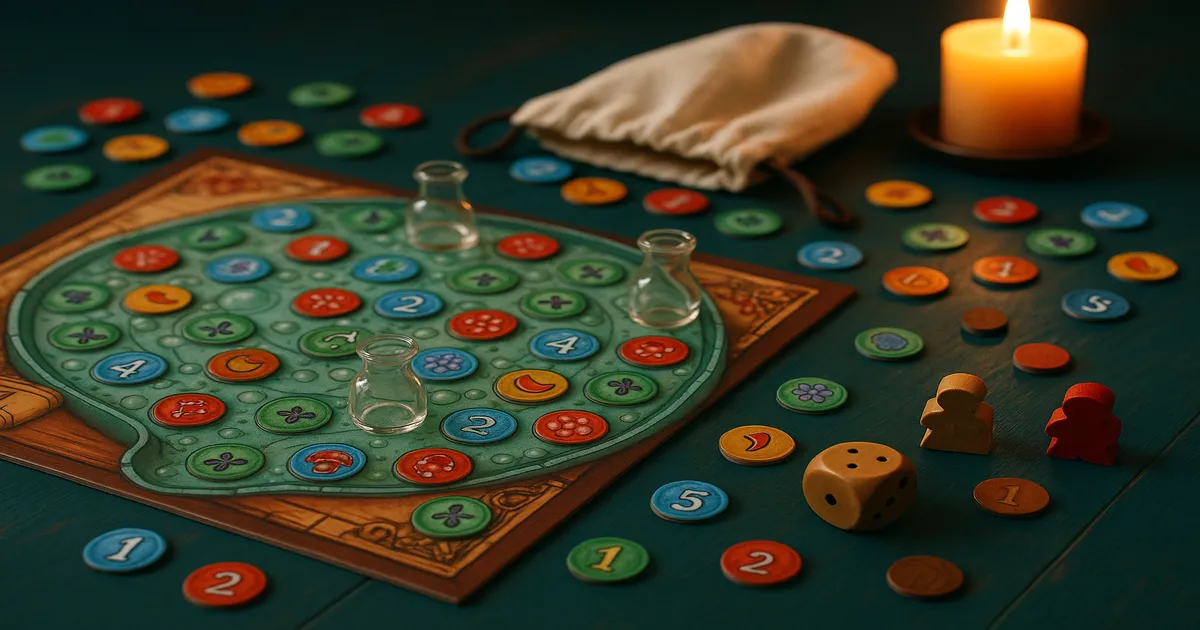
- Simultaneous drawing phase — all players draw chips from their bags one at a time and place them on a spiral “cauldron” on their player board. Everyone goes at the same time, which is why downtime is basically nonexistent.
- White chip rule — white chips (cherry bombs) are your enemy. If the total pip value of white chips you’ve drawn exceeds 7, your pot explodes.
- Stop or keep going — after each draw, you decide: stop safely, or risk another pull.
- Explosion consequences — if you explode, you choose between taking coins or scoring points. Not both. Players who stop safely get both. This is the central tension of every round.
- Buying phase — spend your coins at the ingredient market to buy new colored chips and add them to your bag for future rounds.
Nine rounds, then final scoring.
Ingredient Chips: Colors, Powers, and Synergies
What Each Chip Color Does
- Orange — bonus movement on the scoring track when drawn
- Green — lets you draw extra chips from your bag
- Purple — scores bonus points based on where your token sits on the spiral
- Blue — provides rubies for special bonuses
- Red — lets you reposition an already-placed chip further along the spiral
- Black — high-value movement chips with no special power, but they push you far along the cauldron
- Yellow — generates coins for the buying phase
Book 1 vs Book 2: Which Side Should You Use?
Every player board is double-sided. Book 1 is the recommended starting side — simpler powers, more forgiving. Book 2 changes the effects meaningfully and adds complexity. Play Book 1 for your first few games regardless of experience level, then flip once everyone knows what they’re doing. Mixing sides works fine and is actually a good solution when you have players of different experience levels at the table.
Best Chip Combos Reddit Players Swear By
The green + orange combo gets the most discussion. Green chips pull extra chips from your bag; orange chips push you further along the scoring track. Stack them and you can have explosive scoring turns. It’s not subtle, but it works.
Red chips are consistently underrated by new players. Moving an already-placed chip further along the spiral sounds minor until you realize how much it shifts your cauldron position without adding new draw risk. Worth buying earlier than most first-timers do.
Black chips are the premium ingredient — high movement, no ability — but they’re only worth adding once your bag is already under control. Dropping blacks into a volatile bag is asking for trouble.
Component Quality: What’s Good, What Isn’t
The Cloth Bags and Chips
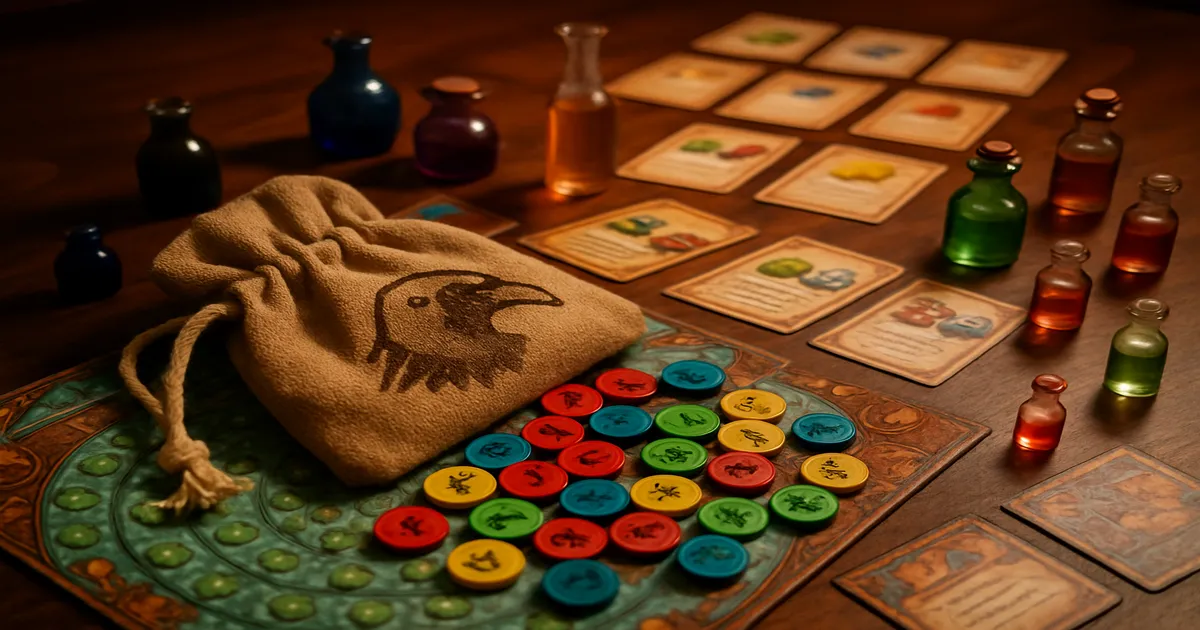
The cloth bags are the star of the show. There’s something genuinely satisfying about reaching in blind and not knowing what you’ll pull — it’s tactile in a way card-based games can’t replicate. The chips themselves are thick, punchy cardboard that feels substantial in hand. (Quacks of Quedlinburg)
Where the Components Fall Short
The player boards are unlaminated, which means spills are a real risk during a game with a lot of table activity. Many players pick up a neoprene playmat to protect them. The box insert is average at best — after punching, the chips don’t stay organized. The near-universal recommendation from hobbyist communities is to bag them by color using small zip bags or a dedicated organizer.
Accessibility and Table Space
Color-blind accessibility is a genuine concern worth flagging. Chip color is the primary identifier for every chip’s power, and while there are some shape and symbol differences, the game wasn’t designed with color vision deficiency in mind. If that affects anyone in your group, check BGG’s accessibility threads before buying — community-made solutions exist, but they require extra effort.
At four players, the table footprint is real. Each person has their own spread-out cauldron board plus the central market. A standard dining table handles it fine; a coffee table won’t.
Strategy Guide: How to Actually Win
The Golden Rule of White Chips
Keep your white chip count low relative to your colored chips. A bag with 2 whites and 10 colored chips is dramatically safer than 4 whites and 8 colored chips. This sounds obvious, but it’s easy to lose track of while chasing powerful ingredients. The strategic corollary: sometimes the right move is to buy nothing. Skipping a purchase round to avoid adding whites is a legitimate play, especially mid-game when your bag is already volatile.
When to Push and When to Stop
Experienced players do real-time pip math — tracking how many white pips are still in the bag and calculating the odds of hitting the 7-pip explosion threshold. It’s not as complicated as it sounds: if you’ve drawn 5 white pips and you know there’s one more 2-pip white left in your bag, you should probably stop. The other factor is what you actually need. If you’re already scoring well and don’t need coins, stopping safely to score points is often better than pushing for a slightly better cauldron position.
Round-by-Round Priorities
Early rounds (1–3): Be aggressive. Your bag is small and you know almost exactly what’s in it. Push harder than feels comfortable — the math is on your side.
Mid-game (4–6): This is where buying decisions matter most. Think about what your bag needs, not just what looks powerful in the market.
Late game (7–9): Stop buying things that won’t see enough plays to matter. New chips added in round 8 will only see one more round of play — rarely worth the white chip risk. Focus on maximizing your scoring position and spend your rubies rather than hoarding them.
Using the Catch-Up Mechanic
Players who are behind on the scoring track receive more coins each round. Don’t panic if you fall behind early — use the bonus coins to build a better bag while the leader is spending their coins on less impactful purchases. I’ve seen games flip dramatically in the final three rounds because someone used a coin advantage to load up on greens and oranges.
Common Mistakes New Players Make
- Misreading the explosion penalty — you don’t lose everything when you explode. You choose coins OR points. New players often think it’s catastrophic; it’s really just suboptimal.
- Forgetting the droplet marker — this tracks where your spiral starts each round and advances each game, meaning your cauldron fills up faster as the game goes on. Easy to forget, changes the math significantly.
- Chip timing confusion — chips you buy go into your bag for next round, not the current one.
- Skipping fortune teller cards — these provide end-game bonuses that players consistently forget during final scoring. Read them at the start and keep them visible.
- Over-buying white chips early — the starting bag already has several whites. Adding cheap ingredients that come with whites attached can spiral out of control quickly.
Quacks of Quedlinburg vs. Similar Games
Push-Your-Luck Alternatives
| Game | Weight | What’s Different |
|---|---|---|
| Incan Gold | 1.2/5 | Simultaneous, faster, simpler — great filler |
| Can’t Stop | 1.3/5 | Abstract classic, no building element |
| Celestia | 1.5/5 | Lighter, pure push-your-luck, no bag |
| Clank! | 2.5/5 | Deck-building + dungeon crawl, heavier |
Quacks vs. Clank!: Which Should You Buy?
Clank! (2–4 players, 60–90 minutes, BGG weight 2.5/5) is the most common comparison. Both combine bag-building with push-your-luck elements, but they feel quite different in practice. Clank! is a competitive dungeon crawl with a board to explore and a more complex ruleset. Quacks is faster to learn, plays simultaneously, and has essentially no downtime.
If you want something with more adventure and a board to move around, get Clank!. If you want something that teaches in 10 minutes and plays four people without anyone waiting around, Quacks is the better call. Honestly, both are worth owning if you play regularly — they scratch different itches.
Expansions: What to Buy and When
The Herb Witches: Is It Essential?
Pretty much, yes. The Herb Witches adds a fifth player, pumpkin chips with interesting new powers, and a herb witch character you can hire for special abilities. It integrates cleanly and adds meaningful variety without bloating the rules. If you’re buying Quacks knowing you’ll play it more than a handful of times, The Herb Witches should be on your list.
The Alchemists and The Doctors
Both add new chip types and mechanics and are solid expansions that deepen the game further. Neither is as universally recommended as The Herb Witches, though. Get those after you’ve worn out the base game plus Herb Witches.
Mega Box vs. Base Game: Reddit’s Take
If the Mega Box (base game + expansions bundled) is available at a reasonable price, the community consensus leans toward just getting that. The savings over buying separately are real, and The Herb Witches in particular is something most repeat players end up buying anyway. That said, if you’re not sure the game will click with your group, start with the base game — it’s a complete, fully satisfying experience on its own.
For younger players or families with kids under 10, Quacks & Co.: Quedlinburg Dash is a lightweight racing spin-off worth knowing about. Different game entirely, but it shares the chip-pulling DNA.
Quacks of Quedlinburg Review Reddit: FAQ
Does luck ruin Quacks of Quedlinburg, or is there real strategy?
Luck is absolutely present and will occasionally cost you a round through no fault of your own — that’s by design. The strategy lives in your bag composition decisions, when you choose to stop pulling, and how you manage your coins. Players who understand the chip math and buy thoughtfully will win more often than players who don’t, but you won’t win every game. If that bothers you, this isn’t your game.
What is the best player count for Quacks of Quedlinburg?
Three or four players is where the game really sings. The market gets competitive, there’s more energy at the table, and the simultaneous drawing creates great shared tension. Two players works well and is a great way to learn — faster, more controlled, but the market feels less contested and the game plays a bit quieter.
Is the Quacks of Quedlinburg Mega Box worth buying over the base game?
If you can find it at a fair price, yes. The Mega Box bundles the base game with expansions and saves money compared to buying separately. The catch is availability — it’s not always easy to find in stock. If you’re unsure whether the game is for you, start with the base game and upgrade later.
How does Quacks of Quedlinburg play at 2 players compared to 4?
At two players, the game is faster, the market is less contested, and the overall experience is more relaxed — good for learning the rules without chaos. At four players, the simultaneous drawing creates real shared energy. Everyone’s watching each other’s cauldrons, reacting to who’s pushing their luck, and the market competition adds meaningful decisions. Both work; four players is just more of an event.