Quick Answer: Reddit’s heavy Euro community considers Great Western Trail one of the best board games ever made — a top-20 BGG title that combines deck building, worker placement, and trail movement into something genuinely elegant. It’s complex, rewards repeated plays, and has a learning curve that will humble your first session. Get the second edition.
If you searched “great western trail review reddit” hoping for a quick verdict, here it is: the community loves this game, almost without reservation. The caveats are real — setup takes a while, the first game usually runs long, and the scoring system has a way of making new players feel like they missed something — but experienced Euro gamers consistently put this in their top five. Let’s talk about why, and whether it’s right for you.
One quick note before we dive in: “Great Western Trail” is also the name of a long-distance hiking trail running from Canada to Mexico. If you ended up here looking for the outdoor trail, you want a different search. This article is entirely about the board game designed by Alexander Pfister.
Quick Reference
| Designer | Alexander Pfister |
| Publisher | Eggertspiele / eggertspiele (2nd ed. published with Pegasus Spiele) |
| Player Count | 1–4 |
| Play Time | 75–150 minutes |
| BGG Weight | ~3.7 / 5 |
| BGG Ranking | Top 20–30 all-time |
What Reddit Actually Thinks of Great Western Trail
The consensus on r/boardgames and the dedicated r/greatwesterntrail subreddit is about as positive as it gets for a heavy game. GWT gets recommended constantly to anyone asking for “the next step up” from games like Wingspan or Viticulture. It’s not a beginner game — people say that clearly — but for players ready for it, it tends to stick around in collections permanently.
The most common criticism isn’t about the game design itself. It’s about the first edition’s iconography and the learning curve around Kansas City delivery scoring. Both problems are largely solved by the second edition — and by reading this article before your first play.
Great Western Trail Gameplay Overview
You’re a cattle rancher. You move your cowboy pawn along a trail from Texas to Kansas City, resolve actions along the way, and deliver your herd for points. Then you do it again. The game is built around multiple “drives” — each trip to Kansas City is a scoring opportunity, and the whole engine you’re building is designed to make each successive drive more valuable than the last.
On your turn: move your pawn forward at least one space, then resolve whatever location you land on. That’s the structure. The depth comes from what those locations do and how you’ve set up your board.
Location types include:
- Your own buildings — free actions that power your engine
- Neutral or opponent buildings — cost you cattle cards or money to use
- Hazards (flooding, rockfall, drought) — require discarding cattle cards to pass
- Teepees — grant certificates or points
- Kansas City — where you score your current hand of cattle cards
Deck Building, Workers, and the Railroad
Your hand of cattle cards is your herd. You want a lean, high-quality deck — diverse breeds, high individual values. The temptation to grab cheap cattle early is real, and it’s the most common mistake new players make.
Three worker types define your strategic identity:
- Cowboys help you buy better cattle from the market
- Craftsmen let you build better buildings on the trail
- Engineers advance your train along the railroad track
All three feel necessary, which creates constant tension. You can’t fully invest in all of them, so choosing your emphasis early is one of the game’s central decisions.
Don’t sleep on the railroad. I’ve watched new players completely ignore it and then wonder why they lost by 30 points. Advancing your train unlocks station master tiles, city delivery bonuses, and significant end-game points. It’s not a side system — it’s a parallel scoring engine that needs at least moderate investment from everyone at the table.
How Kansas City Scoring Works
When you reach Kansas City, you reveal your hand and score based on diversity and value. More different cattle types means more points. Higher individual card values means more points. This is the heart of the game, and it’s the part most rules explanations underserve — make sure you understand the delivery matrix before your first play. Final scores typically land between 50 and 120+ points, coming from deliveries, buildings, railroad stations, objective cards, and end-game bonuses.
Components and Production Quality
The first edition (2017) is a solid physical product, but the iconography requires frequent rulebook consultation. Players have spent entire games unsure what a symbol on a building tile actually does.
The second edition (2021) fixed the iconography, rewrote the rulebook to address the most common rules confusion, and added a solo mode. The art direction also got a refresh that most players consider an improvement.
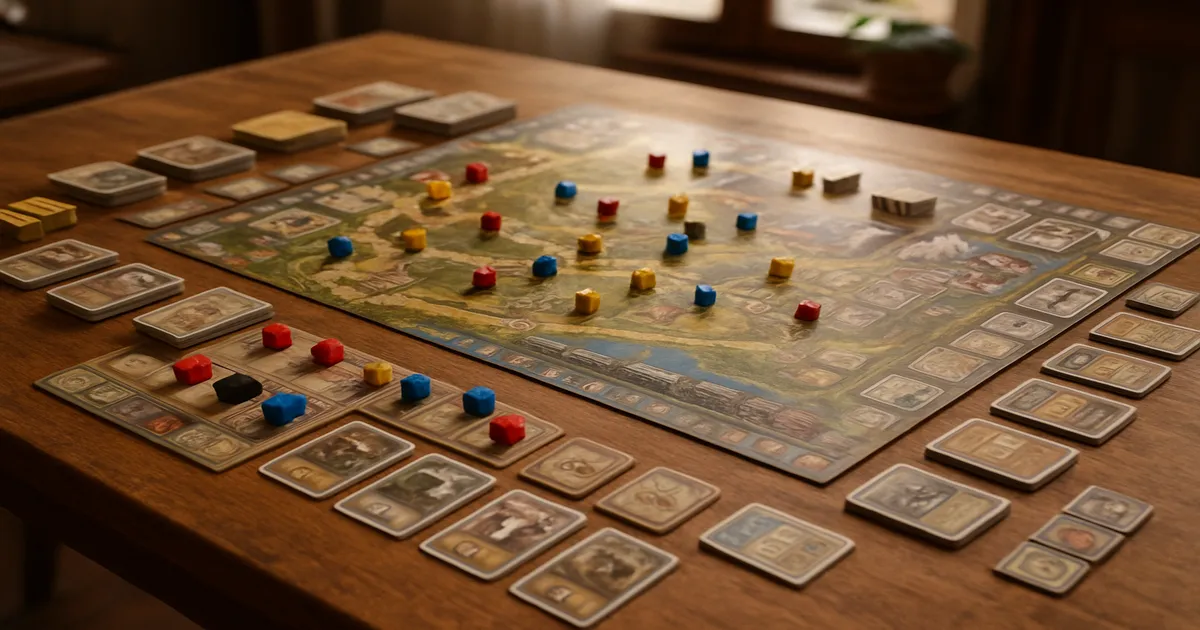
This game takes up real estate. The main board is large, and once you add player boards, the cattle market, and the railroad track, you’re filling a full dining table. Setup runs 20–30 minutes your first few times. If you want to cut that down, a custom insert makes a noticeable difference.
Which edition should you buy? Second edition, no question. First edition owners don’t need to upgrade unless the iconography frustration bothers them or they want the solo mode — the game itself is the same. But for new buyers, there’s no reason to hunt down a first edition copy.
Common Mistakes New Players Make (According to Reddit)
These come up constantly in GWT threads. Read this before your first game.
Bloating your deck with cheap cattle. More cards feels like more options, but delivering a hand full of low-value duplicates is how you score 12 points when you should have scored 25. Only buy cattle that genuinely improve your average hand quality.
Ignoring the railroad. Pure trail builds almost never win. Plan at least a moderate railroad strategy from the start and keep an eye on which stations your opponents are racing toward.
Failing to plan movement around opponent buildings. Landing on an opponent’s building costs you resources. Experienced players count spaces ahead and route around them. It sounds tedious — it becomes second nature after a few games.
Misunderstanding Kansas City delivery scoring. A hand of five identical high-value cattle scores much less than five different breeds. Study the delivery matrix before you play.
Upgrading workers too slowly. New players sometimes hoard money instead of investing in worker upgrades. That’s backwards. Upgrade aggressively in the early-to-mid game. The powerful actions unlocked by upgraded workers are what make your engine actually run.
Forgetting objective cards. Objectives can swing 10–20 VP. Check them every turn. Public objectives are visible to everyone — if one aligns with your strategy, race for it.
Great Western Trail Strategy Tips
Pick an Archetype and Commit
GWT punishes players who try to do everything equally. The three main archetypes:
- Cowboy-heavy: Premium cattle, frequent deliveries. Straightforward and powerful.
- Craftsman-heavy: Build strong buildings early in the trail; strong mid-game engine that compounds over multiple drives.
- Engineer-heavy: Railroad-focused; can score enormous points from station tiles and city bonuses, but requires real commitment to pay off.
All three are viable. Pick one and build around it. Spreading yourself thin is how you finish last.
Cattle, Buildings, and Tempo
Aim for 4–6 high-value, diverse cattle types by mid-game. Place buildings early in the trail so you land on them multiple times per game. And don’t underestimate tempo — completing more drives than your opponents gives you more scoring opportunities. Every extra turn you spend fiddling before delivering is a turn your opponents might be scoring.
Great Western Trail Review: How It Compares to Similar Games
vs. Brass: Birmingham — One of the most common Reddit comparisons, and for good reason. Both are top-tier heavy Euros with massive BGG followings. Brass is more purely network-focused; GWT adds the deck-building layer. They scratch different itches. If you love one, you should probably own both.
vs. Terraforming Mars — Both are heavy engine builders with multiple paths to victory. GWT has more spatial and movement elements; TM is more purely card-driven. GWT has the more elegant core design, but TM has the edge in variety thanks to its massive card pool.
vs. Wingspan / Viticulture — Wingspan (BGG weight ~2.4) and Viticulture are significantly lighter. They share the engine-building DNA but GWT demands much more. Think of them as what you play before you’re ready for GWT, not instead of it.
vs. Maracaibo (same designer) — Maracaibo has a stronger narrative element and a campaign mode; GWT is more elegantly focused on its core systems. Both are excellent. Different enough to coexist in a collection.
Expansions and Standalone Variants
Rails to the North extends the railroad system with new mechanics. It’s well-regarded but not necessary — the base game is complete on its own. Worth picking up once you’ve played the base game enough to want more.
Great Western Trail: New Zealand is a sheep-farming standalone that’s lighter and more accessible than the base game. Plays faster, smaller footprint. A reasonable entry point if the base game’s complexity feels daunting.
Great Western Trail: Argentina (2022) introduces unique mechanisms while keeping the GWT DNA intact. Well-received by the community, though it hasn’t had as much time to accumulate the deep strategy discussion that the base game has.
Honest advice: don’t buy the expansions first. Play the base game a dozen times, then decide. There’s enough replayability here to last years.
Frequently Asked Questions
Is Great Western Trail worth buying for heavy Eurogame fans? Yes, without much hesitation. GWT has earned its place in the BGG top 20–30. The combination of deck building, movement, and worker placement is rare and genuinely well-executed. If you enjoy heavy strategy games, this one belongs in your collection.
What’s the best player count? Reddit consensus leans toward three players as the sweet spot — enough competition to make building placement and railroad racing meaningful, without the longer runtime that four players adds. Two players works well but plays differently, with less contested movement. Four is great if your group can handle the time commitment.
How long does it take to learn? Your first game with a teach will typically run 2.5–3 hours. The rules aren’t brutally complex, but there are a lot of interacting systems and Kansas City scoring takes a full game to really click. By your third or fourth play, experienced groups can finish in 90 minutes.
Is the second edition worth it if you own the first? Probably not, unless the iconography frustration bothers you or you specifically want the solo mode. The game itself is the same. The second edition improvements are meaningful for new buyers, but existing first edition owners generally don’t feel compelled to double-dip.
Is Great Western Trail good at two players? Yes, but it plays differently. The trail feels less contested, building placement matters in different ways, and the game moves faster. Some players prefer it at two for the tighter, more focused experience. Others feel it loses competitive tension. Worth trying — just know it’s a different game than at three or four.