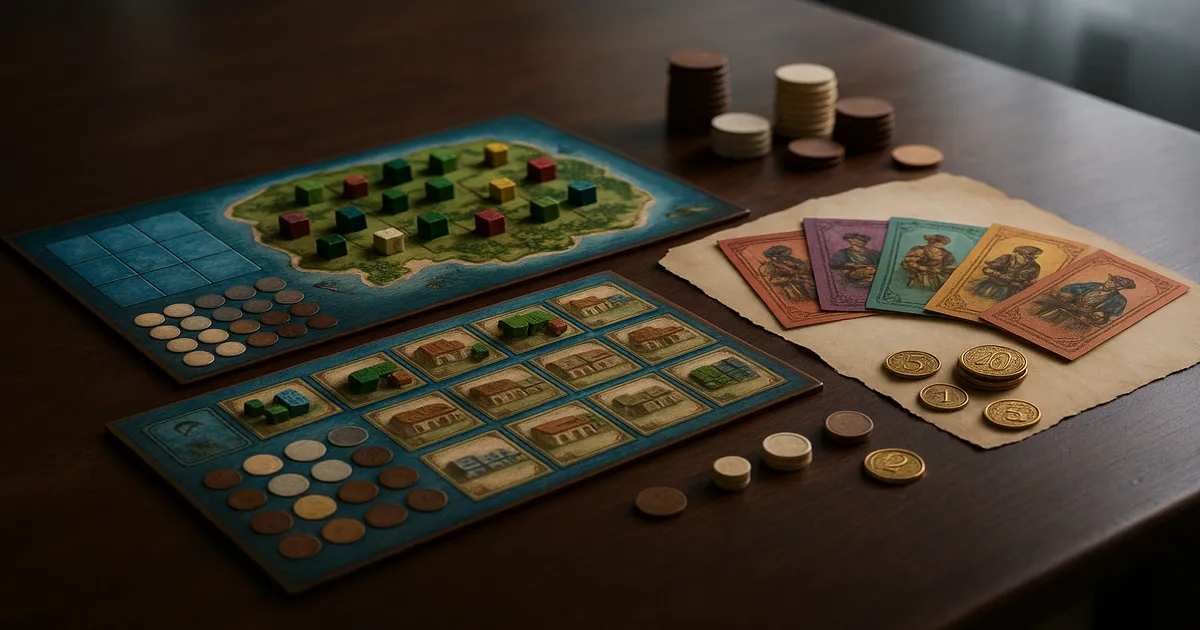
Quick Answer: Puerto Rico 1897 is a 2–5 player heavy euro where players take turns selecting roles — Settler, Builder, Captain, and more — to grow crops, construct buildings, and ship goods for victory points. Everyone acts on each chosen role, but the selector gets a bonus. The 2022 Ravensburger edition updates the beloved 2002 classic with better components and a more historically grounded setting, while keeping the core mechanics completely intact.
If you want to know how to play Puerto Rico 1897, start here: the whole game runs on one of the most elegant role-selection systems ever designed. Every decision ripples outward. What you pick helps you — but it also hands something to every opponent at the table. That tension is what’s kept this game on serious gamers’ shelves for over two decades.
What Is Puerto Rico 1897 and How Does It Work?
You’re a plantation owner in 1897 Puerto Rico. Each round, players take turns picking a role card from a central display. Pick the Captain, and everyone ships goods — but you ship first and score a bonus VP. Pick the Builder, and everyone can construct — but you pay one doubloon less. The player who reads the table best, sequences their actions most efficiently, and targets the right large building wins.
| Detail | Info |
|---|---|
| Players | 2–5 (best at 3–4) |
| Age | 12+ |
| Play Time | 90–150 minutes |
| BGG Weight | ~3.4 / 5 |
| MSRP | ~$50–$60 USD |
| Designer | Andreas Seyfarth |
| Publisher | Ravensburger (2022) |
What’s in the Box
- 1 main game board (colonist supply, ships, trading house)
- 5 individual player island boards
- Plantation tiles (quarries, corn, indigo, sugar, tobacco, coffee)
- Building tiles (small buildings at 1–3 cost, large buildings at 6 cost)
- Colonist discs (wooden workers)
- Goods tokens (corn, indigo, sugar, tobacco, coffee)
- VP chips (1s and 5s)
- Doubloons (1s and 5s)
- 7 role cards
- 3 cargo ships (sized to player count)
- Governor token
The 2022 Ravensburger edition is a genuine upgrade over old Alea printings — thicker cardboard, cleaner building iconography that cuts mid-game rules lookups, and warmer artwork throughout. The goods tokens run a bit small for how much you handle them, which is a minor but real annoyance. Box organization is solid, though dedicated organizer fans will want something like a Folded Space insert to really tame the chaos.
One practical note: five player boards plus the central board needs a full dining table. Plan accordingly.
How to Play Puerto Rico 1897: Core Rules Explained
Role Selection — The Heart of the Game
On your turn, pick one of the seven role cards. You perform that role’s action with a special bonus privilege. Then every other player performs a weaker version of the same action. After all roles have been picked (or the round cycles back to the Governor), unused role cards each gain a doubloon — making them increasingly attractive next round.
That doubloon accumulation is a clever balancing mechanism. If nobody’s picking the Prospector, eventually it’s sitting there with four free doubloons attached, and suddenly it’s worth grabbing.
The Seven Roles
| Role | Everyone Does | Selector’s Bonus |
|---|---|---|
| Settler | Place a plantation tile | May take a quarry instead |
| Mayor | Receive colonists from the ship | +1 extra colonist |
| Builder | Construct a building | Pay 1 doubloon less |
| Craftsman | Produce goods on staffed buildings | +1 extra good of a type you produce |
| Trader | Sell one good to the trading house | Sells first, gets +1 doubloon |
| Captain | Ship goods to cargo ships for VP | +1 VP |
| Prospector | Nothing | Take 1 doubloon from supply |
The Prospector is almost always the weakest pick. New players grab it constantly because “free money” sounds appealing. Don’t. There’s nearly always a better option unless you’re desperately one doubloon short of something important.
Staffing Buildings and Plantations
This is the single most common source of confusion for new players, so I’ll say it plainly: a building or plantation does nothing without a colonist disc on it. Zero production. Zero function. The colonist disc is the on/off switch for every space on your board.
The colonist ship refills each Mayor phase with colonists equal to the total number of empty building and plantation spaces across all players — so the supply is dynamic. The more everyone expands, the more colonists flow into the game.
The Trading House
The trading house holds a maximum of four goods — one of each type. When the Trader role is called, players can sell one good for doubloons, but only if that good type isn’t already in the house. Once it’s full, nobody trades until it clears at the end of the round. Don’t build your whole economy around trading if the house is likely to be clogged.
Cargo Ships and Shipping
Three cargo ships sit on the main board, each with a different capacity. When the Captain is called, players must ship if they can — it’s not optional. Each ship holds only one type of good, and you can’t load a type that’s already on a different ship. Leftover goods that can’t be shipped are discarded, with each player keeping one good as a holdover. The Captain selector scores +1 VP on top of normal shipping.
How the Game Ends and How to Score
The Three End-Game Triggers
The game ends immediately when any of these happens:
- The colonist supply runs out
- A player fills all 12 city building spaces
- The VP chip supply is exhausted
When a trigger fires, the current Captain phase finishes — then scoring begins. The game does not complete a full round. This catches people off guard every time.
Final Scoring
Add up three things:
- Shipped goods VP — accumulated on your VP chips throughout the game
- Building VP — the printed value on each building you own (staffed or not)
- Large building bonuses — the big conditional VP from 6-cost buildings
Doubloons are only a tiebreaker. Unspent money is worthless. If you’re sitting on eight doubloons at game end, you played the economy wrong.
The Large Buildings
These 6-cost buildings are often game-deciding. Each rewards a different strategy:
- Guild Hall — bonus VP for production buildings
- Residence — bonus VP for filling your island with plantations
- Fortress — bonus VP for total colonists on your board
- City Hall — bonus VP for violet (non-production) buildings
- Customs House — bonus VP for shipped goods
- Harbor — bonus VP every time you ship goods
Harbor is widely considered the strongest. The bonus compounds every time the Captain is called, and in a typical game that’s a lot of times — I’ve seen Harbor players pull 10–15 extra VP from it in a four-player game. That said, the “best” large building is always the one that fits your engine. If you’ve been stacking production buildings all game, Guild Hall might outscore Harbor in your specific situation. Commit to a target early and build toward it.
Common Mistakes in Puerto Rico 1897
Rules mistakes:
- Thinking only the role-selector acts — everyone acts, only the selector gets the bonus.
- Building without staffing — a sugar mill with no colonist produces nothing.
- Treating Captain as optional — if you have shippable goods and a valid ship, you must ship.
- Forgetting corn is special — it’s the only crop that ships and sells without a processing building.
Strategic mistakes:
- Ignoring large buildings until it’s too late to afford one.
- Over-trading instead of shipping — the Trader gives money, not VP. Players who only trade fall behind on the scoreboard every time.
- Skipping quarries — one quarry saves a doubloon per building; two quarries dramatically accelerates your whole game.
- Not watching opponents — Puerto Rico rewards denial. If your opponent is one building away from completing their City Hall engine, don’t call the Builder and hand them a discount.
How to Play Puerto Rico 1897: Strategy Tips
Early Game
Grab a quarry early. The savings compound — two or three quarries and you’re building large buildings at a significant discount while opponents pay full price. Corn is also worth taking early since it requires zero infrastructure to produce and ship. For your first building, the Small Indigo Plant is a solid default: cheap, gets you producing immediately, and bridges you into the mid-game without overcommitting.
Mid Game
By mid-game you need a large building target. Look at what you already have and pick the large building that fits your existing engine rather than pivoting completely. Committing late is expensive.
Role Selection
Call Captain when you have more goods than your opponents — you score more, and they may have to discard. Call Trader when the house has room for your specific good type. Watch for roles with accumulated doubloons; a role sitting at 3+ doubloons is a windfall you don’t want an opponent scooping.
Builder is a powerful denial tool late in the game. Sometimes you pick it just to deny an opponent the discount — even if you’re not planning to build anything great yourself.
Colonist Efficiency
Over-expanding your board creates a colonist drought that stalls your entire engine. Build what you can staff, not just what looks good on paper. Puerto Rico is a tempo game — falling two or three actions behind in production, colonists, or shipping is very hard to recover from.
Puerto Rico 1897 vs the Original
Mechanically, almost nothing changed. Same roles, same buildings, same victory conditions. What’s different: the thematic framing is anchored to the specific historical period of 1897, component quality is significantly better, and a handful of ambiguous rules from the original got cleaned up. Experienced Puerto Rico players will sit down and feel immediately at home.
If you love the original and play it regularly, 1897 is a quality-of-life upgrade worth having. If you’re new to the game, 1897 is simply the version to buy. Note that older Puerto Rico expansions (like Puerto Rico: Nobles) weren’t designed with the 1897 edition in mind — verify compatibility before purchasing.
A Note on the Theme
The 1897 edition makes a genuine effort to ground the game in a specific historical moment rather than the generic colonial fantasy of the original. Whether it succeeds is a conversation that continues in the hobby, and it’s a fair one to have. The game’s economic mechanics still involve the same plantation-and-labor systems as the original. It’s a better attempt than the 2002 version, but “better” doesn’t mean “resolved.”
Games Like Puerto Rico 1897
| Game | Weight | Play Time | Why Consider It |
|---|---|---|---|
| San Juan | 2.1/5 | 45 min | Same designer, card game cousin, much lighter |
| Race for the Galaxy | 3.0/5 | 45–60 min | Simultaneous role selection, steep learning curve |
| Agricola | 3.6/5 | 90–150 min | Similar weight, worker placement instead of roles |
| Viticulture | 2.9/5 | 45–90 min | Production theme, more accessible, no colonial baggage |
| Concordia | 3.0/5 | 90 min | Similar strategic depth, less confrontational |
San Juan is the obvious first recommendation — same designer, scratches a similar itch in half the time. Race for the Galaxy if you want simultaneous role selection and don’t mind spending a few games learning the iconography. Viticulture if the colonial theme is a dealbreaker — it’s warm, approachable, and none of those complications apply. Concordia if you want similar strategic depth without the direct denial that Puerto Rico rewards.
Frequently Asked Questions About How to Play Puerto Rico 1897
What’s the difference between Puerto Rico and Puerto Rico 1897?
Puerto Rico 1897 is the 2022 Ravensburger update of the 2002 original. The core mechanics are essentially unchanged — same roles, same buildings, same victory conditions. The differences are improved components, revised iconography, minor rule clarifications, and a more historically specific thematic framing. Experienced players will find it immediately familiar.
Is Puerto Rico 1897 good for beginners?
It depends on the beginner. At BGG weight ~3.4/5, it’s firmly in heavy euro territory. Someone who’s played a handful of medium-weight games and wants something meatier will get a lot out of it. A true newcomer will probably find it overwhelming. San Juan covers similar ground at a fraction of the complexity and is a better starting point.
What’s the best player count for Puerto Rico 1897?
Three or four players. At three, the game moves quickly and role denial is sharp without feeling punishing. At four, the full strategic depth opens up. Five works but runs long and can feel chaotic. Two is playable but the dynamics shift significantly — the Prospector appears twice and some strategies that shine at higher counts don’t translate.
How long does a game of Puerto Rico 1897 take?
Expect 90–150 minutes depending on player count and experience. A three-player game with experienced players can finish in under 90 minutes. A five-player game with new players will likely push past two hours. The box says 90 minutes, which is optimistic for first-timers but reasonable once everyone knows the rules.
Do I need any accessories to play Puerto Rico 1897?
Nothing is strictly required — the 1897 edition comes with everything you need. That said, a dedicated insert makes setup and teardown much faster given the sheer number of small components. (Broken Token Puerto Rico Organizer) A card sleeve set for the role cards is also worth considering if you play frequently.