Quick Answer: Puerto Rico is a medium-heavy euro game for 2–5 players where you run a plantation in colonial-era Puerto Rico, taking turns picking role cards that trigger actions for everyone at the table. You score victory points by shipping goods and constructing buildings. Expect around 90 minutes to two hours, and a BGG weight of 3.44/5 — it’s approachable, but it rewards experience.
If you’ve been trying to figure out how to play Puerto Rico board game and keep getting tripped up, you’re not alone. The rules themselves aren’t complicated — it’s the way the systems interact that catches people out. This guide covers everything: setup, the role mechanic, scoring, the mistakes that kill new players, and strategy that actually holds up.
One thing worth knowing before you buy: Puerto Rico has a colonial theme that some players find uncomfortable. The “colonist” tokens historically represented enslaved labor. The 2020 revised edition updated some terminology, though opinions on whether that’s sufficient vary widely in the hobby. Worth knowing upfront.
What’s in the Puerto Rico Box?
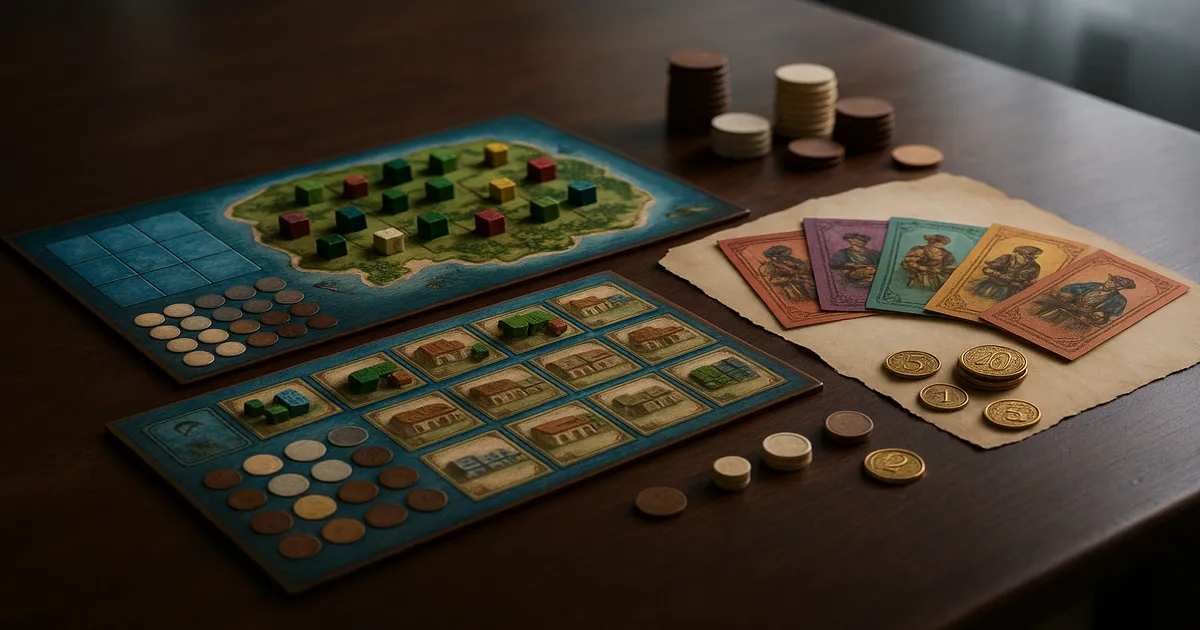
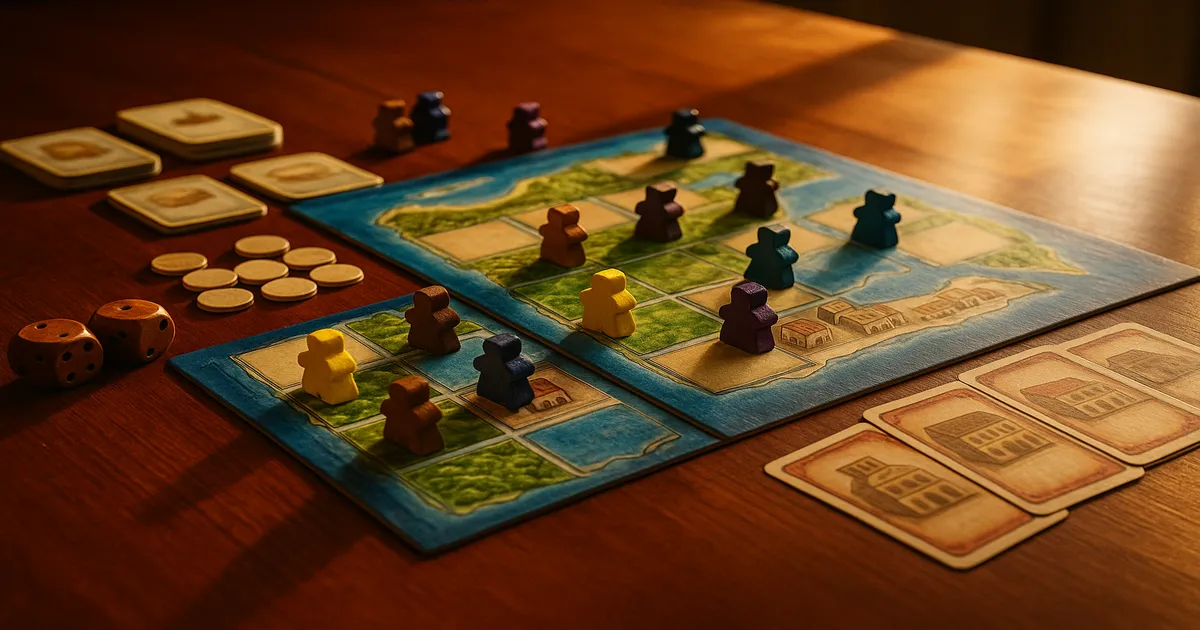
Each player gets a personal island board with spaces for plantations on the left and buildings on the right. Plantation tiles come in five crop types — Corn, Indigo, Sugar, Tobacco, and Coffee — plus Quarry tiles. Buildings split into production buildings (which process goods) and city buildings (which give special powers or bonus VPs at the end).
The wooden goods tokens are genuinely satisfying to handle — little barrels in five colors. Colonist tokens are wooden discs, doubloons are cardboard coins, and VP chips come in 1 and 5 denominations. It’s a functional euro aesthetic. No miniatures, no linen-finish cards — clean and practical.
Seven large role cards sit in the center of the table, alongside three cargo ships (capacities 4, 5, and 6) and a Trading House board. The Trading House holds up to four goods — one of each type — before it clears.
Original vs. 2020 Revised Edition: The 2020 edition is meaningfully better. Cleaner iconography, a reorganized rulebook, and an official 2-player variant the original never had. If you’re buying new, get the 2020 version.
Setting Up Puerto Rico
Place the supply board in the center with the three cargo ships nearby, empty. Stack colonists on the colonist ship — the exact number scales with player count, so check the rulebook.
Starting doubloons are staggered to offset the first-player advantage: the first player gets 0, the second gets 1, the third gets 2, and so on. Each player starts with one Indigo plantation, except the last one or two players, who start with Corn instead. Don’t skip this detail — it matters for balance.
Buildings go into the central supply, sorted by type. At lower player counts, some buildings are removed; the rulebook specifies which ones. Skipping this step skews the economy noticeably.
The 2-player variant uses a modified role card display and some adjusted rules. Three to four players is where the game really shines. Five works, but it runs long and gets harder to plan around — not the recommended starting experience.
How to Play Puerto Rico: The Role Mechanic
The Core Mechanic: Role Selection and the Follow Rule
This is what makes Puerto Rico tick. On your turn, you pick one of the available role cards. You perform that role’s action first, with a privilege bonus unique to you. Then every other player performs the same action — without the bonus. Simple to explain, endlessly interesting to navigate.
The player holding the Governor token goes first each round. After everyone has selected one role in clockwise order, the round ends. Any role cards that weren’t chosen get a doubloon added to them, making them progressively more attractive. The Governor token passes left, and a new round begins.
All Seven Role Cards Explained
| Role | Everyone Does | Privilege Bonus (Selector Only) |
|---|---|---|
| Settler | Place a plantation tile | Choose from face-up tiles (others draw randomly) |
| Mayor | Receive colonists from the ship | Receive one extra colonist |
| Builder | Construct one building | Build at 1 doubloon discount |
| Craftsman | Produce goods on staffed plantations | Produce one extra good |
| Trader | Sell one good to the Trading House | Sell first; receive 1 extra doubloon |
| Captain | Ship goods for VP chips | Ship first; receive 1 extra VP chip |
| Prospector | Nothing | Receive 1 doubloon (only the selector benefits) |
The Prospector is the odd one out — nobody else does anything when you pick it. You get a free doubloon, which sounds fine until you realize you just handed everyone else a free tempo. Pick it sparingly, and only when the board genuinely offers you nothing better.
Producing and Shipping Goods
To produce a good, you need a plantation of that type and the corresponding production building, and both must have colonist tokens on them. Corn is the exception — it produces directly from a staffed plantation with no building required. This is the most common rules confusion for new players, so it’s worth repeating.
During the Captain phase, you must ship as many goods as legally possible. No opting out. Each cargo ship holds only one type of good — you load onto a matching ship or start filling an empty one. Once a ship is full, it clears at the end of the round.
The Trading House accepts one good per Trader phase, up to four goods total (one of each type). If the Trading House already contains your good type, you can’t sell. Once all four slots are filled, nothing trades until it clears.
How to Win Puerto Rico: Scoring and End Game
Three Ways the Game Ends
The game ends when any of these happen during a round:
- The colonist supply runs out
- The VP chip supply runs out
- A player builds their 12th building
The current round always finishes before scoring.
How Victory Points Are Scored
Add up three things:
- VP chips earned from shipping
- Printed VP values on your buildings — but only if each building has at least one colonist on it
- Large building bonuses
Large buildings cost 10 doubloons and take up two spaces on your board. Each scores differently:
- Guild Hall — 1 VP per small production building, 2 VP per large production building
- City Hall — 1 VP per city building (including itself)
- Customs House — 1 VP per 4 VP chips earned
- Fortress — 1 VP per 3 colonists on your island
- Residence — 4–7 VP based on occupied plantation spaces
Pick the one that fits how you’ve actually been playing. Buying City Hall when you have five production buildings is just wasted potential.
Ties go to the player with the most doubloons plus goods remaining — rarely comes up, but worth knowing before someone has to scramble for the rulebook.
Common Mistakes New Players Make
Rules mistakes:
- Forgetting the privilege bonus — the role selector gets an extra benefit, and it matters
- Trying to hold goods back during Captain — you can’t; if you can legally ship, you must
- Mixing goods on a ship — one type per ship, no exceptions
- Assuming the Trading House is unlimited — four goods max, one of each type
- Not staffing buildings — an unstaffed building scores zero VP and does nothing
- Taking the Quarry discount when following — the discount only applies when you select Builder, not when you’re following
- Using a fixed colonist ship refill — the ship refills each round with colonists equal to the number of vacant spaces across all players’ boards, which changes every round; many groups get this wrong
Strategic mistakes:
Ignoring large buildings is the most common way new players lose. Those buildings can swing 10–15 VP in a single scoring, and experienced players are planning for them from round three onward.
Over-trading is the other one. Doubloons feel good to accumulate, but they don’t win games. VPs do. If you’re sitting on eight doubloons and haven’t shipped much, something’s gone wrong.
Puerto Rico Strategy: Tips That Actually Work
Early game: Get a production chain running fast — Small Indigo Plant or Small Sugar Mill in the first two rounds if possible. Corn is underrated: it produces without a building and fills ships efficiently. The Hacienda, which lets you draw an extra plantation whenever Settler is chosen, is one of the strongest early buildings in the game. Grab it if you can. (Stonemaier Games Viticulture Metal Coins)
Mid game: Transition toward Tobacco and Coffee when you can afford it — they trade for more and ship for more. Diversify your goods so you’re not competing with another player for the same ship. Keep one eye on the colonist supply; if it’s draining fast, be aggressive about choosing Mayor.
Late game: You need both the doubloons and a colonist to staff your large building — plan for both. Match the building to your strategy. If you’re ahead, look for ways to accelerate the end triggers. If you’re behind, slow things down.
Role selection meta: The best role pick isn’t always the one that helps you most — it’s the one that creates the biggest gap between you and everyone else. If an opponent is one colonist away from staffing their large building, maybe don’t choose Mayor. Let doubloons pile on roles you don’t need; when you finally take them, the windfall is real.
Puerto Rico vs. Similar Games
San Juan is Puerto Rico’s card game cousin, designed by the same Andreas Seyfarth. Same role selection feel, same production-to-VP loop, but it plays in 45 minutes and is much easier to teach. If you want to introduce someone to this style of game, start here.
Race for the Galaxy uses a similar role selection mechanic but everyone chooses simultaneously — which speeds things up but makes the learning curve steeper. It’s a great game, but it’s not a gentler alternative to Puerto Rico. Different beast entirely, with a notoriously dense iconographic language.
Concordia offers comparable strategic depth with a Roman trade theme — no colonial baggage, and the card-driven action system feels fresh. If the theme of Puerto Rico puts you off but you want that same level of strategic engagement, Concordia is the move.
Before you buy anything, try Puerto Rico for free on Board Game Arena. It’s one of the best implementations on the platform, and a few async games online will tell you more than any review.
Frequently Asked Questions About Puerto Rico
How long does a game of Puerto Rico take?
With experienced players, 90 minutes to 2 hours. First-timers will likely run 2.5 to 3 hours, especially at higher player counts. If you’re teaching new players, four is a better starting count than five.
What happens when the colonist supply runs out?
It triggers the end of the game — the current round finishes, then everyone scores. The colonist ship refills each round with colonists equal to vacant building and plantation spaces across all players, so the supply can drain faster than new players expect.
Can you hold goods back during the Captain phase?
No. If you can legally ship — meaning you have a good that matches a ship already in use, or an empty ship is available — you must ship as much as possible. The only exception is if all ships carrying your good type are full and no empty ships remain.
What’s the difference between the original and 2020 editions?
The 2020 revised edition has improved iconography, a cleaner rulebook, updated graphic design, and an official 2-player variant. Some terminology was revised to address colonial theme criticism. Mechanically it’s the same game, but the 2020 edition is the better product in every practical way.
Is Puerto Rico good for two players?
The 2020 revised edition added an official 2-player variant with adjusted rules, and it works reasonably well. The original 2002 edition was designed for 3–5 players, and the 2-player experience without those adjustments was generally considered unsatisfying. If you’re primarily playing with two people, make sure you’re getting the 2020 edition.