Quick Answer: Clank! A Deck-Building Adventure is a 2–4 player game where you build a card deck to move through a dungeon, grab a valuable artifact, and escape before the dragon kills you. Each turn you play cards to generate three resources — Boots to move, Skill to buy cards, and Swords to fight — while managing the noise (Clank) you make, which fills a bag that determines dragon attack damage. First player out with the most points wins.
Clank! A Deck-Building Adventure is one of those rare games that genuinely earns its hype. If you’re trying to figure out how to play Clank! A Deck-Building Adventure, you’re in the right place. Designed by Paul Dennen and published by Renegade Game Studios in 2016, it blends deck building with a physical dungeon map and a bag-drawing tension mechanic that no other game quite replicates. It was nominated for the Kennerspiel des Jahres 2017 — the German award for “connoisseur” games — and it deserved it.
Quick Facts
- Players: 2–4 (best at 3–4)
- Play Time: 60–90 minutes (add 30 minutes for new players)
- BGG Weight: 2.42/5
- Designer: Paul Dennen
- Publisher: Renegade Game Studios
What’s in the Clank! Box?
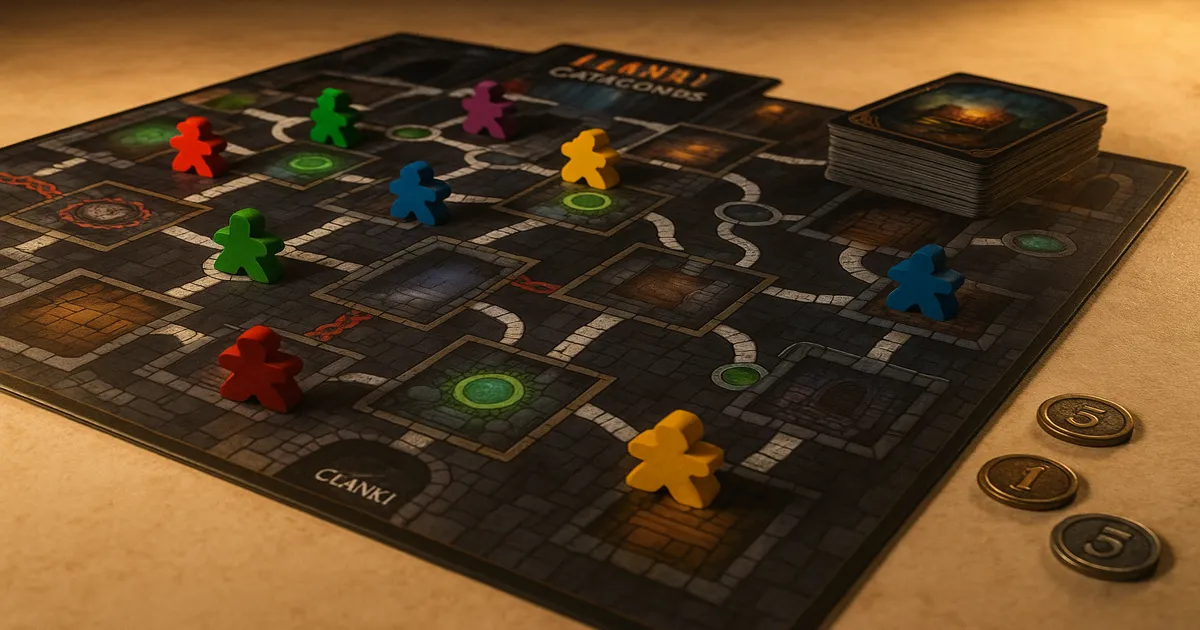
The board is double-sided — one layout for standard play, one alternate. It’s split into two zones: the upper dungeon (safer, closer to the entrance) and the lower dungeon (deeper, better loot, more danger). A Depth Marker divides them, and a Dragon Threat Track runs along the edge. That track matters a lot once things heat up.
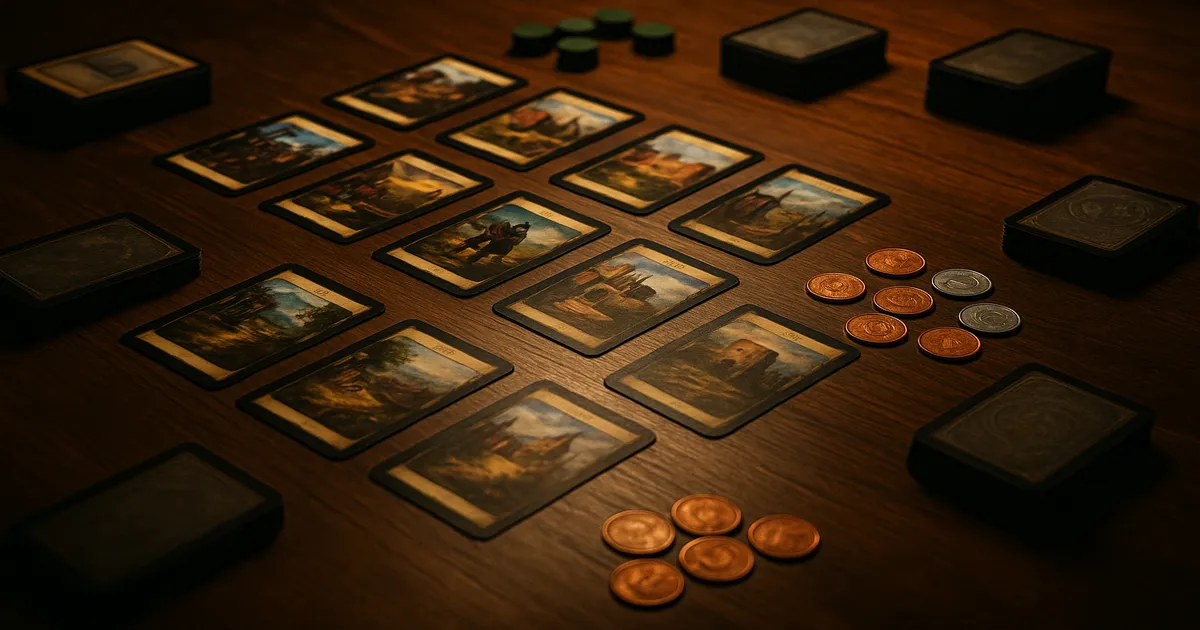
Every player gets an identical 10-card starter deck. The shared market — called the Dungeon Row — shows five face-up cards from the Dungeon Deck at any time, plus a Reserve section with cards that are always available. There are 200+ cards in the box total.
The tactile highlight, though, is the dragon bag. Each player has roughly 30 colored cubes, and there are 24 black dragon cubes. The bag is a genuine cloth drawstring bag, and watching it fill with cubes over the course of a game creates a real, growing sense of dread. It’s one of those components that just feels right.
You’ll also find gold tokens in various denominations, artifact tokens worth 20–30 points each, minor secret tokens, mastery tokens, monkey idol tokens, and 10 health tokens per player. The art throughout is bright, cartoonish, and genuinely funny — it leans into fantasy tropes with a winking humor that makes the whole thing feel cohesive rather than generic.
Cards are standard cardstock — functional, not premium. If you’re planning to play this a lot, sleeve them. The tokens are thick punched cardboard and hold up well.
Setting Up Clank! A Deck-Building Adventure
Place the board in the center. Put artifact tokens face-down on their designated rooms — deeper rooms get higher-value artifacts. Set the Dragon Marker at the starting position on the threat track. Place gold and minor secret tokens on their indicated spaces.
Shuffle the Dungeon Deck and deal five cards face-up to form the Dungeon Row. Set up the Reserve section. Any cards with a Dragon Attack symbol that appear during setup trigger immediately — flip them face-down and apply their effect before play begins.
Each player takes their 10-card starter deck, shuffles it, and draws 5 cards as their opening hand. Take 10 health tokens and place your meeple at the dungeon entrance. Finally, put 24 black cubes into the dragon bag. No player cubes go in yet — those get added as attacks trigger during play.
How a Turn Works in Clank!
Play Cards, Spend Resources, Discard
Play as many cards as you want from your hand of five. Each card generates some combination of Skill (the coin icon), Boots (movement), and Swords (combat). Resources accumulate for the whole turn — play everything first, then decide how to spend it.
Use Skill to buy cards from the Dungeon Row or Reserve. When you buy a card, replace it immediately — this is one of the most commonly forgotten rules. The card goes to your discard pile, not your hand.
Use Boots to move between rooms. Each connection has a boot cost printed on it; some also require Swords to fight a guardian. You can split movement however you like across the turn. Fighting monsters is optional unless a room requires it for entry — they cost a set number of swords and usually reward you with gold or tokens.
At the end of your turn, discard everything you played and everything left in your hand, then draw five new cards. If your deck runs out, shuffle your discard pile into a new one. You never hold cards between turns.
What Triggers a Dragon Attack?
Dragon Attacks are not automatic at the end of each round — this trips up almost every new player. They’re triggered by cards with a Dragon Attack symbol (a dragon head icon) that appear in the Dungeon Row. When one triggers: all cubes currently in the Clank Area go into the dragon bag, black cubes are added based on the current threat track level, and then a set number of cubes are drawn. Each cube drawn of your color deals one damage.
How to Play Clank!: The Clank Mechanic and Dragon Attacks
Clank represents the noise your thief makes stumbling through the dungeon. Certain cards and actions tell you to add your colored cubes to the central Clank Area on the board. The more Clank you generate, the more of your cubes end up in that pile — and eventually in the bag.
The dragon gets angrier as the game progresses. A higher rage level means more black cubes added per attack. Paradoxically, a bag stuffed with black cubes is slightly safer for any individual player — but attacks also become more frequent and more cubes are drawn per attack. You can’t avoid damage once your cubes are in the bag, which is why Clank management is so important.
The Monkey Idol is worth significant points but generates Clank every time you move while carrying it — not just when you pick it up. New players almost always forget this. It’s a calculated risk, not a free points grab.
Escaping, Scoring, and Winning
To escape, you need to carry an artifact back to the dungeon entrance. You must physically move your meeple there — holding an artifact token doesn’t save you automatically.
If you’re knocked unconscious in the upper dungeon (above the Depth Marker), you’re rescued and still score your points, albeit with a penalty. If you go down in the deep dungeon, you score zero. Nothing. It’s brutal, it’s the right call for the game’s tension, and new players absolutely need to know it going in.
The moment the first player escapes, a countdown begins. Remaining players get roughly 3–4 more turns before the game ends — usually less time than it feels like, especially if you’re deep in the dungeon.
Scoring breakdown:
- Artifact value — the biggest single swing, usually 20–30 points
- Gold — collected from cards and room tokens
- Mastery tokens — bonus VP tokens found in the dungeon
- Minor secrets — small token bonuses from rooms
- Card victory points — some purchased cards have VP printed on them
Artifact value is so dominant that chasing a 25-point artifact over a 20-point one is worth real strategic effort — but only if you actually escape.
Common Mistakes and How to Avoid Them
Rules errors that cause confusion:
- Not refilling the Dungeon Row immediately after a purchase
- Treating Dragon Attacks as round-based rather than event-driven
- Using a flat cube count for attacks instead of checking the threat track
- Missing the zero-score rule for dying in the deep dungeon — this one always stings when players discover it at the end of the game
- Forgetting Monkey Idol Clank on each move, not just on pickup
Strategic mistakes that cost you the game:
Going too deep too early with a deck that can’t generate enough boots for the return trip is probably the most common way to lose. A close second is ignoring the escape countdown — once that first player exits, the clock is brutal. Over-investing in combat cards is also a trap. Swords matter, but boots win games. And buying too many mediocre cards dilutes your deck and slows your cycling speed.
Strategy Tips for Clank! A Deck-Building Adventure
Prioritize boots early. A deck that reliably generates 3–4 boots per turn gives you dungeon flexibility that sword-heavy decks can’t match. Keep your deck lean — 12–15 cards that cycle fast will outperform a 20-card deck with slightly better average quality. You want to see your best cards as often as possible.
Cards that let you draw additional cards are disproportionately powerful because they effectively increase your resources for that turn. Make sure you have at least one or two high-Skill generators so you can afford the expensive 6–7 Skill cards when they appear.
Before you move, calculate the round-trip boot cost to your target artifact. Don’t go deeper than your deck can reliably support. A 20-point artifact you carry out beats a 30-point artifact you die holding.
On Clank management: minimize noise early in the game. When the bag is sparse, your cubes represent a higher percentage of the total, making each draw more dangerous for you personally. Late game, when the bag is full of black cubes, your individual cubes matter less — that’s when you can afford to play noisier cards.
Watch where your opponents are positioned. If someone is close to the exit with an artifact, you need to accelerate — you probably have fewer turns than you think.
How Clank! Compares to Other Deck-Building Games
Dominion invented the genre and is still worth playing, but it’s a pure card game — no board, no movement, no push-your-luck element. Clank!‘s physical dungeon map and bag mechanic are what set it apart from everything else in the genre.
| Game | Key Difference |
|---|---|
| Thunderstone Quest | Also dungeon-crawl themed, but longer, more complex, heavier on combat |
| Star Realms | Head-to-head only, no board, purely combat — much faster at 20–30 min |
| Ascension | Similar market-row structure, no board movement, more abstract |
| Aeon’s End | Cooperative, no shuffling mechanic, completely different feel |
Expansions Worth Exploring
Clank! In! Space! is a standalone sci-fi reimplementation with a modular board — many experienced players consider it a refinement of the base game. Clank! Legacy: Acquisitions Incorporated is a campaign version designed with the Penny Arcade team, with permanent board changes and a narrative arc; it’s excellent. For base game expansions, Sunken Treasures and The Mummy’s Curse both add new dungeon boards and mechanics. Adventuring Party adds asymmetric player characters, which freshens up the base game considerably for groups who’ve played it a lot.
If you’re playing Clank! regularly, a card game insert or organizer makes setup dramatically faster.
Frequently Asked Questions About Clank!
Is Clank! good for beginners to deck-building games?
Yes, genuinely. At BGG weight 2.42/5, it’s one of the more accessible deck builders out there, and the physical dungeon board gives new players something concrete to engage with beyond just card interactions. The three resources — Boots, Skill, Swords — are intuitive after one turn. It’s an ideal second or third board game for someone just getting into the hobby.
What happens if you die in the dungeon in Clank!?
It depends entirely on where you fall. If you’re knocked unconscious in the upper dungeon (above the Depth Marker), you’re rescued and still score your points with a penalty. If you die in the deep dungeon, below the Depth Marker, you score zero — nothing. This makes health management genuinely important, not just a formality.
How does the dragon attack work in Clank!?
Dragon Attacks are triggered by cards with a Dragon Attack symbol appearing in the Dungeon Row — not automatic at the end of each round. When one triggers, all cubes in the Clank Area go into the dragon bag along with black cubes determined by the current threat track level. Then a set number of cubes are drawn; each cube of your color deals one damage.
What is the difference between Clank! and Clank! In! Space!?
Clank! In! Space! is a standalone sci-fi reimplementation — same core mechanics, different theme, modular board instead of a fixed one, and some rule refinements. You don’t need the base game to play it, and the two don’t directly combine (though crossover expansions exist). Many players who’ve tried both prefer In! Space! for its replayability, but the original is the better starting point.
How many players is Clank! best with?
Clank! supports 2–4 players and works at all counts. Community consensus is that 3–4 is the sweet spot — competition for artifacts and dungeon positions creates more meaningful tension. Two-player is still fun and slightly more forgiving, since the bag fills more slowly and you can afford to be a bit more aggressive about going deep.