Quick Answer: To get better at Codenames, build two habits and stick to them: Spymasters should screen every clue against the Assassin before committing to it, and Operatives should check the Assassin before touching any card. Beyond that, the single biggest improvement most groups can make is playing repeatedly with the same partners — shared vocabulary is genuinely half the game.
Codenames (2–8 players, 15–30 minutes) is one of those rare games that takes five minutes to learn and years to actually master. Designed by Vlaada Chvátil and published by Czech Games Edition, it’s been a staple of game nights since 2015 — and for good reason. If you’re trying to figure out how to get better at Codenames, the good news is that the skills are learnable. The bad news is that most players plateau early because they keep making the same few mistakes without realising it. This guide covers both roles — Spymaster and Operative — plus team communication, common mistakes, and how to practice outside of game night.
How Codenames Works (The Bits That Actually Matter)
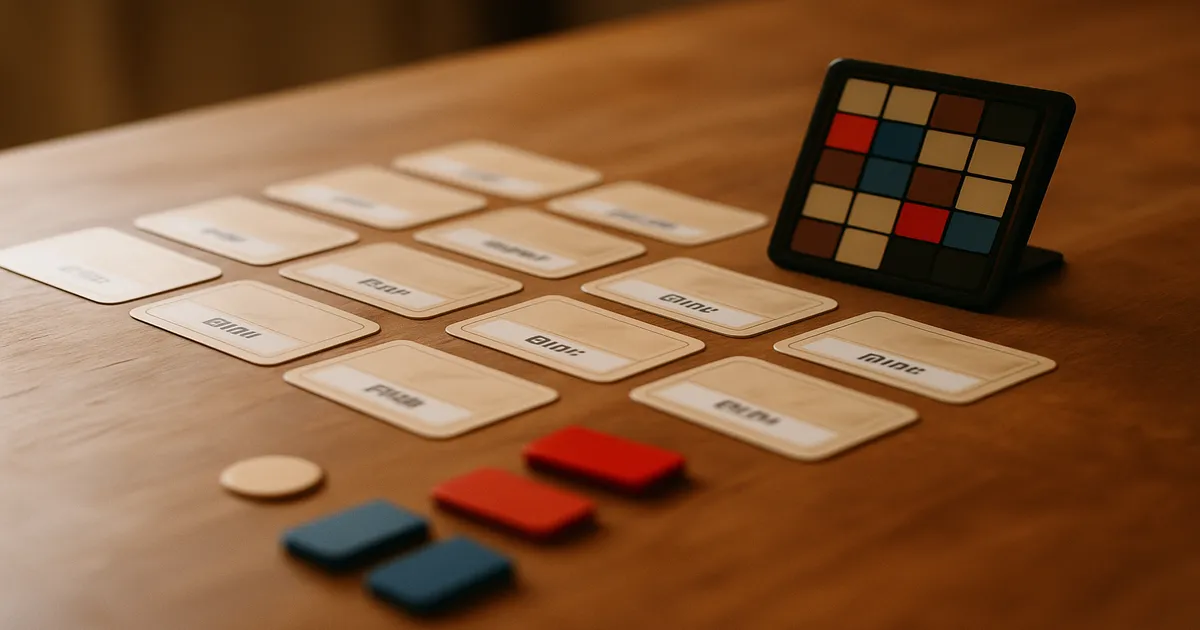
Twenty-five word cards sit in a 5×5 grid. A key card — visible only to the Spymasters — assigns each word to one of four categories: Red team, Blue team, neutral Bystander, or the Assassin. One team has 9 words to find, the other has 8. The team with 9 goes first, which balances the slight disadvantage of having more ground to cover.
The Spymaster gives exactly one word and one number per turn. The word connects multiple cards on the grid; the number says how many. Operatives discuss openly, then touch cards one at a time. Hit the right card and keep guessing. Hit a Bystander and your turn ends. Hit an opponent’s card and you’ve just done their job for them. Hit the Assassin and you lose — immediately, no appeals.
That last point is worth repeating: the Assassin is sudden death. Everything in this guide flows from that fact.
Rules Beginners Get Wrong
A few mistakes come up in almost every new group:
- The Assassin ends the game instantly. Not “lose a turn.” Game over. This changes how both roles should be played.
- The +1 bonus guess. Teams can always guess one more card than the Spymaster’s number. Clue was “Animal, 2”? You get up to 3 guesses. Most new players miss this entirely.
- Legal clue words. You can’t use any word visible on the table, any morphological form of a board word (can’t say “Swimming” if “Swim” is in the grid), or any homophone. Cluing by position or first letter is also off the table.
- Bystanders end your turn. No continued guessing after hitting a neutral card.
- Spymasters must stay poker-faced. A wince, a smile, a sharp inhale — all against the rules. If you can’t keep a straight face, hand the role to someone who can.
How to Get Better at Codenames as a Spymaster
This is the harder role, and it’s where most games are won or lost.
Map the Entire Board Before Your First Clue
Spend 30–60 seconds before your first turn categorising all 25 words. Which of your cards cluster naturally? Which are isolated? Which sit dangerously close to the Assassin or opponent cards? This mental map is the foundation for everything else — skipping it is like navigating without looking at the road.
Screen Every Clue Against the Assassin First
For every clue you’re considering, ask: “Could my team reasonably connect this word to the Assassin?” If there’s a plausible path, scrap it and find another. This is the single most important habit a Spymaster can build. More games are lost to Assassin hits from well-intentioned clues than from any other cause.
Then Screen Against Opponent Cards
A clue that leads your team to an opponent’s card is almost as bad. You’ve burned a guess and advanced their board. After clearing the Assassin check, run through the opponent’s words and ask whether any of them could plausibly match your clue.
Clue Construction: A Few Reliable Approaches
- Category clues — “Mammal, 3” for Whale, Dog, Bear. Reliable and clear, but often too obvious to pull off more than once or twice.
- Connotation clues — cluing by feel or association (“Cozy, 2” for Fireplace and Cabin). Creative and can catch operatives off guard in a good way, but riskier because you’re betting on shared associations.
- Umbrella clues — one word that pulls together 3–4 of your cards under a broad concept. High reward, but these need to pass both screens especially carefully.
- Sacrifice plays — sometimes a card is so isolated or so close to a dangerous word that a deliberate 1-clue is your best move. Take the safe point and move on.
Watch out for “poison pill” words — cards so strongly associated with the Assassin or opponent cards that any clue touching them is too risky. Identify these early and route around them.
Think Two Turns Ahead
Don’t just think about your current clue. If you clue “Ocean, 2” now and leave Whale for later, make sure there’s a clean clue waiting for Whale next round. Good Spymasters are playing chess; bad ones are playing checkers.
Use the +1 Bonus Guess as a Planning Tool
You can deliberately leave a card uncovered, knowing your operatives will pick it up with a bonus guess on a future turn. This frees you to spend a full turn on a different cluster. It requires trust, but it’s a legitimate strategy — not a workaround.
How to Get Better at Codenames as an Operative
Check the Assassin Before You Touch Anything
Make this a ritual. Before your hand moves toward any card, ask: “Is this the Assassin?” If you’re not sure, say so out loud. One second of hesitation has saved countless games.
Trust the Number, But Don’t Be Enslaved by It
If the clue was “3” and you’ve only found 2 cards, don’t bail early — look harder. The Spymaster put that number there for a reason. That said, the number is a ceiling, not a requirement. If you’ve hit 2 cards and the third candidate feels wrong to everyone, stop. Taking a guaranteed 2 beats gambling on a shaky 3.
Read What Your Spymaster Is Avoiding
Low-number clues near dangerous cards are a signal. If your Spymaster gives “River, 1” when you can see three river-adjacent words on the board, they’re steering you away from something. Unusual or oddly specific clues often mean the Spymaster was working around a minefield. Pay attention to what they’re not pointing at — it tells you as much as the clue itself.
Know When to Stop
The bonus guess is a gift, not an obligation. Using it when the team is split or uncertain is one of the most common ways games fall apart. If confidence isn’t high, take the win on the cards you’ve already found and end your turn.
Team Communication: The Hidden Skill
Run a Proper Guess Discussion
Name your candidates out loud before touching anything. “I’m thinking Storm and Lightning for this clue — what does everyone else see?” This gives the whole team a chance to weigh in before momentum locks you into a choice. And if someone raises a concern, actually consider it rather than steamrolling.
Build a Shared Vocabulary With Your Spymaster
This is where repeated play with the same group pays off enormously. Over time, you learn whether your Spymaster thinks literally or metaphorically, whether they lean on pop culture, whether they favour obscure connections or obvious ones. That shared language is worth more than any single strategy tip in this guide.
Establish a ‘Stop’ Culture
Agree before the game that anyone can pause and say “I’m not comfortable with this guess” — and that the team will actually stop. Not a veto, just a signal to slow down. This one practice alone will cut your Assassin hits dramatically.
Common Mistakes That Are Costing You Games
Spymaster mistakes:
- Giving a clue without checking the Assassin first
- Ignoring how strongly your clue connects to opponent cards
- Swinging for a 4-card clue in turn one before you know how your operatives read the board
- Reacting visibly when operatives guess wrong (or right)
- Forgetting to plan around the +1 bonus guess
Operative mistakes:
- Touching a card before the team has discussed the clue
- Letting one loud player drive every decision
- Treating the Spymaster’s number as a requirement rather than a ceiling
- Getting excited about a clue and forgetting to check the Assassin
- Ignoring previous unguessed clues when deciding how to use the bonus guess
How to Practice and Improve Faster
Play Online for More Reps
The official online version at codenames.game is free and lets you play with friends remotely or jump into games with strangers. Volume matters — the more boards you see, the faster your pattern recognition develops.
Debrief After Every Game
This is the practice most groups skip, and it’s genuinely where improvement happens. After the game, have the Spymaster walk through their intended clues: what were they connecting, and what were they avoiding? Compare that to what the operatives actually heard. The gaps in that conversation are exactly where you need to improve.
Practice Giving Clues Solo
Lay out a Codenames board, assign yourself a key card, and try to construct clues with no time pressure. You’ll quickly discover which words are easy to connect and which are poison pills. It sounds tedious, but it builds the kind of pattern recognition that makes you faster and more creative under pressure.
If you don’t own a physical copy yet, the standard edition is the obvious starting point. For groups that play a lot, Codenames: Duet is worth picking up too — it’s a cooperative two-player version that’s excellent for practising the Spymaster role without an audience.
Switch Roles Regularly
Spymasters who’ve never played Operative forget how confusing an ambiguous clue feels from the other side. Operatives who’ve never been Spymaster don’t appreciate how much the Assassin and opponent cards constrain every decision. Switch roles regularly — it makes you better at both.
Frequently Asked Questions
What makes a good Codenames clue?
A good clue connects multiple of your team’s cards clearly, passes the Assassin check, and doesn’t point toward opponent cards. The best clues are unambiguous enough that your operatives land on the right cards without much discussion. If you need to explain the clue afterward, it probably wasn’t clean enough.
How do you avoid hitting the Assassin in Codenames?
Spymasters should screen every clue against the Assassin before committing — ask “could my team reasonably connect this clue to the Assassin?” and if yes, find a different clue. Operatives should make checking the Assassin a pre-guess ritual: before touching any card, explicitly ask whether it could be the Assassin.
How many cards should a Spymaster try to clue at once?
New Spymasters should default to 2-card clues until they’re comfortable with the screening process. Swinging for 4 or 5 too early is how teams hit the Assassin or gift cards to the opponent. A reliable 2 beats a risky 4 almost every time.
Does playing Codenames online actually help?
Yes, significantly. Playing at codenames.game gives you more reps than game night alone can, and reps are how you build board-reading speed and clue pattern recognition. The main thing you miss online is the debrief conversation, so try to play with people you can talk to afterward.
What is the +1 bonus guess rule?
Operatives can always guess one more card than the Spymaster’s number. So if the clue was “Animal, 2,” the team gets up to 3 guesses. The extra guess is typically used to pick up a card from a previous clue that was skipped — but it’s optional, and teams can stop at any point before hitting their maximum.