Quick Answer: Rising Sun is a 3–5 player negotiation and area control game set in mythological feudal Japan. Players lead asymmetric clans through three seasons of political maneuvering, monster summoning, and blind-bid combat — forming alliances one season and betraying them the next. If your group loves deal-making and direct confrontation, this is one of the best games in the hobby.
Learning how to play Rising Sun board game starts with accepting one uncomfortable truth: combat is almost secondary to politics. Designed by Eric M. Lang and published by CMON, Rising Sun (2018) rewards players who negotiate loudly, pick allies strategically, and know exactly when to stab a partner in the back. The rules themselves aren’t that complicated — it’s the social layer that takes a session or two to click.
How to Play Rising Sun: The Core Loop
Each of the three seasons follows the same rhythm. Players pair into public alliances. Then comes the Political Phase — the heart of the game — where players draft and play mandate cards that let everyone recruit troops, summon monsters, collect coins, or (crucially) betray their ally. Finally, battles resolve across contested provinces using a blind coin-bidding system. Three seasons, tally VP, highest score wins.
Key stats:
- Players: 3–5
- Play Time: 90–120 minutes for experienced groups; budget 2.5–3 hours for a first play
- BGG Complexity: ~3.0 / 5
- BGG Rating: ~7.7 / 10
- Designer: Eric M. Lang | Publisher: CMON
Components and Setup
What’s in the Box
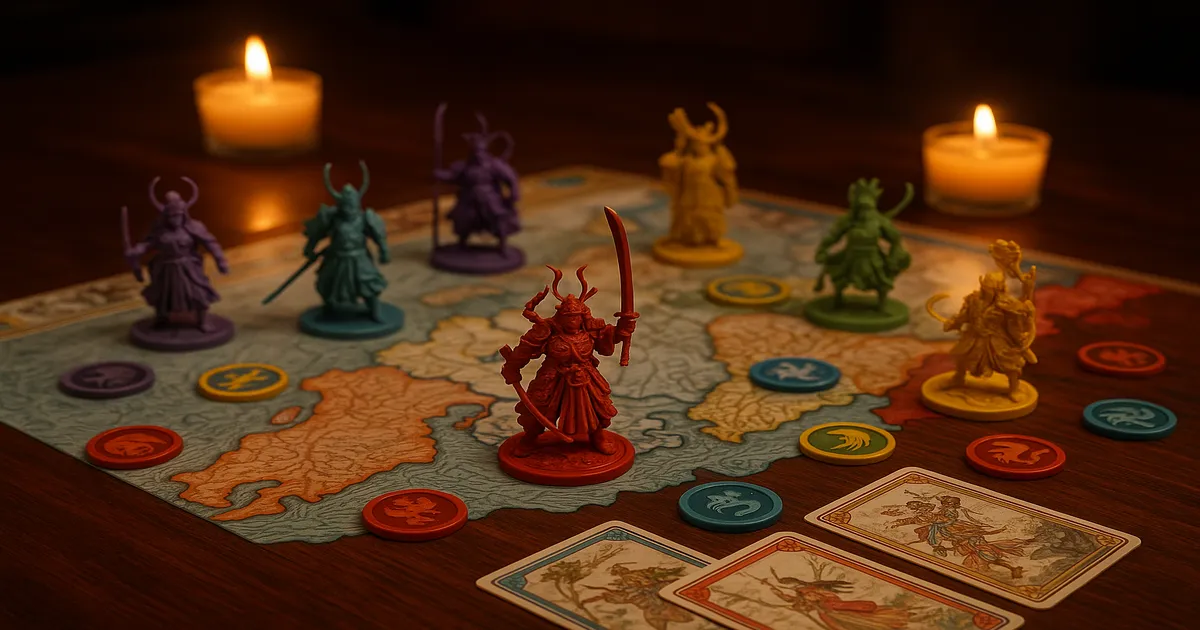
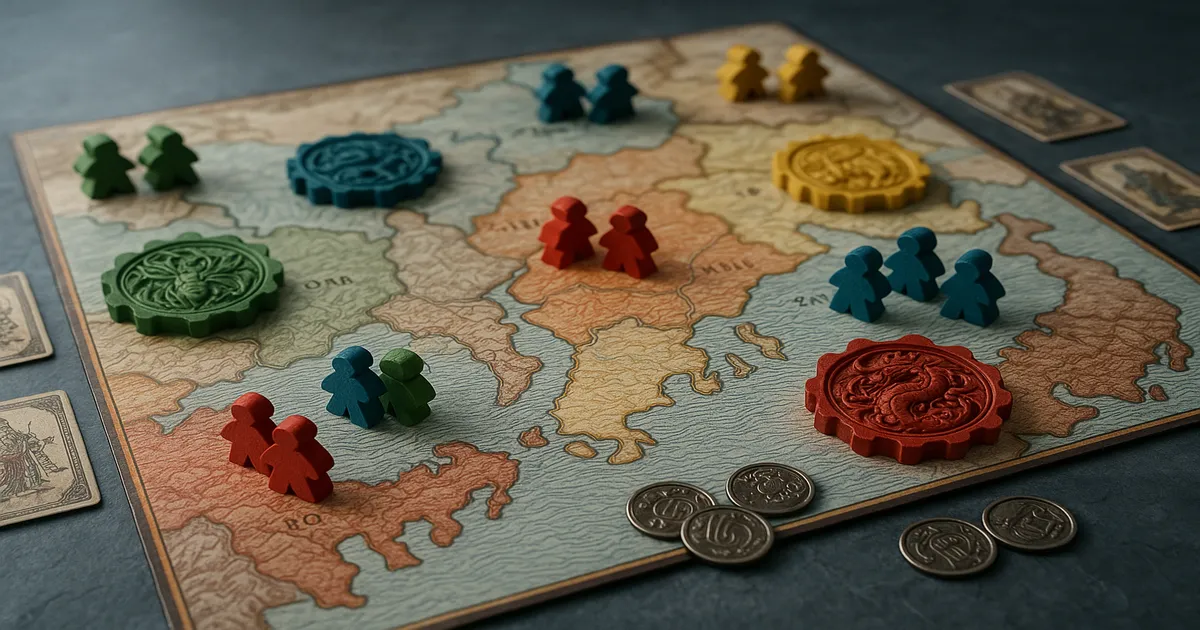
The retail box is packed. You get a large board (Japan divided into provinces), five clan screens, clan miniatures for each faction (Bushi soldiers, Shinto strongholds, and a Daimyo per clan), seven monster miniatures, political mandate cards, virtue tiles, season cards, war province cards, cardboard coins, Ronin tokens, VP tokens, hostage tokens, and an Honor track printed on the board.
The miniatures are genuinely some of the best in the hobby. Adrian Smith’s art direction gives the whole thing a cohesive, dramatic look — the Jorogumo spider-woman and the Oni sculpts are showstoppers. If you backed the Kickstarter campaign (which raised over $4.2 million in 2017), you got metal coins, extra clans, and the Kami Unbound expansion included. Retail buyers can pick up most of that content separately.
The cardboard coins in the retail version are functional but feel cheap next to everything else. A metal coin upgrade set is worth it if you play this game regularly.
Setup
- Lay out the board and place the season and war province cards in their spots.
- Each player picks a clan, takes their screen, figures, and ability tile.
- Place all monster miniatures near the board — they’re recruited during play, not at setup.
- Distribute starting coins and set each clan’s Honor marker on the track.
- Shuffle the political mandate cards and deal starting hands per the season card instructions.
Plan for a full dining table. Five clans and seven monster miniatures fully deployed is genuinely impressive to look at, but it needs the room. First-play setup takes 20–30 minutes; experienced groups get it down to 10–15.
Game Structure: The Three Seasons
The game runs exactly three rounds — Spring, Summer, and Autumn. Each season has four phases, and this repeating loop is the foundation for everything else.
Phase 1 — Tea Ceremony: Players pair into public, mutual alliances. Allies share Harvest income and can’t attack each other in War. Alliances reset completely every season. Don’t get attached.
Phase 2 — Political Phase: Players draft and play mandate cards. Everyone simultaneously chooses the full Mandate Action or the weaker Virtue Action. The player who revealed the card gets their chosen action plus a bonus. You’re never purely choosing for yourself — you’re choosing what action the whole table takes.
Phase 3 — War Phase: Any province contested by non-allied clans goes to battle. Players secretly bid coins across four advantages, combat strength is calculated, and provinces are awarded.
Phase 4 — Seasonal Cleanup: Coins reset, certain tokens are removed, the game advances. Anything you didn’t spend is gone — there’s no carrying coins between seasons.
The Political Phase: All 7 Mandates Explained
Recruit — Place Bushi soldiers onto the map. Bread-and-butter presence-building.
Marshal — Place a Shinto stronghold or summon one of the seven monsters. Prioritize this in Season 1. Getting your monster on the board early is almost always correct.
Train — Gain a Ronin token or buy a Virtue tile. Ronin are flexible combat resources; Virtues are persistent power upgrades that compound over the game.
Harvest — Collect coins from provinces you control. New players consistently undervalue this. Without coins, you can’t bid in the War Phase — and the War Phase is where VP gets decided.
Betray — Force your current ally to remove one of their figures from the board. This is the most misunderstood mandate in the game. It targets your ally, not your enemy. That’s intentional. It’s the source of the game’s central social tension, and it’s absolutely brutal when timed right.
Hire Ronin — Gain Ronin tokens directly. Useful for building a combat reserve without committing to the Train mandate.
Imperial Poets — Gain Honor based on province control. Honor doesn’t score VP directly, but it breaks combat ties — which can be the difference between winning and losing a key battle.
How to Play Rising Sun: The War Phase
Battles and Blind Bidding
Any province where non-allied clans have figures becomes a battle. War province cards set the resolution order. Each player secretly distributes coins across up to four advantages — highest bidder wins each one:
- Seppuku — Your figures die, but you gain Honor and Ronin equal to figures lost
- Hostage — Capture an enemy figure worth VP at game end
- Imperial Poets — Gain VP equal to your figures in the province right now
- Hire Ronin — Add Ronin tokens to your force for this battle
Combat strength is simple: Bushi + Shinto + Monster strength + Ronin tokens. Highest total wins the province and scores VP. Ties go to whoever has higher Honor.
Seppuku Is a Tool, Not a Punishment
New players see Seppuku and assume they should never bid on it. That’s wrong. Bidding Seppuku in a battle you’re going to lose anyway turns a defeat into Honor and Ronin — resources you’ll use in the very next fight. Experienced players use it deliberately, especially in Season 1 when the map is still being established.
Coin management matters enormously here. Blowing your treasury on an early, low-value province is probably the single most common mistake in the game. Identify your two or three most important provinces each season and save your coins for those.
Clans, Virtues, and Monsters
The Five Clans
- Dragonfly — Mobile and opportunistic; can move figures freely
- Lotus — Built for combat; gains extra Ronin
- Bonsai — Territory control engine; cheaper Shinto placement
- Koi — Economic flexibility; gains coins more easily
- Moon — Starts with higher Honor; tiebreaker advantage from turn one
Virtue Tiles
Acquired via Train mandates and permanent for the whole game: Warrior (combat strength), Sincerity (Harvest bonus), Glory (VP for provinces), Zeal (Shinto bonus), Piety (monster summoning bonus). Two or three relevant Virtues for your clan is a significant power spike.
Monsters
Players who skip monster summoning almost always lose. It’s not close. Monsters add combat strength and score VP through unique conditions — they’re doing two jobs at once. Get one on the board in Season 1.
Rough pairings: Oni of Skulls suits Lotus (rewards aggressive combat); Kappa suits Bonsai or Dragonfly (rewards province control); Tanuki suits Koi (rewards coin spending). Even a suboptimal pick still gives you combat strength, so don’t overthink it — but do pick something that aligns with what you’re actually doing.
Common Mistakes and How to Avoid Them
Rules mistakes:
- Betray targets your ally, not an enemy — this trips up almost every new player
- Honor breaks combat ties; ignoring the track and then losing a key battle to a tiebreaker is a painful lesson
- Monster VP conditions are easy to forget — check monster cards at scoring or you’ll miss points
- Alliances reset every season; your Season 1 ally is not your friend in Season 2
Strategic errors:
- Spreading too thin in Season 1 — the map is large and your figures are few
- Skipping monster summoning entirely
- Playing quietly and hoping the board works itself out (it won’t)
- Spending all your coins in the first battle of the War Phase
Alliances feel permanent, but they’re not — and the game is designed around that tension. Choose allies for functional benefit each season: who helps you Harvest more, who won’t contest your key provinces? Sentiment is a losing strategy.
Strategy Tips by Season
| Season | Focus |
|---|---|
| Spring | Establish territory, summon your monster, form a useful alliance |
| Summer | Maximize Harvest, contest key provinces, evaluate betrayal |
| Autumn | All-in on VP — spend coins aggressively, prioritize monster scoring conditions |
Rising Sun rewards players who talk. Make deals, offer coin payments, propose non-aggression arrangements, threaten betrayal to extract concessions. Silence is a strategic disadvantage. I’ve watched strong mechanical players get demolished by someone who simply out-negotiated them.
Betray when the benefit outweighs the reputational cost — and remember you’ll be forming new alliances next season anyway. In Season 3, betrayal costs you almost nothing socially because the game ends right after.
Rising Sun vs. Similar Games
Rising Sun vs. Blood Rage
Both are Eric M. Lang designs for CMON with exceptional miniatures and similar complexity. The key difference: Blood Rage uses card drafting, Rising Sun uses negotiation. Blood Rage rewards mechanical skill and combo-building; Rising Sun rewards social intelligence and deal-making. If your group prefers figuring out systems over talking to each other, Blood Rage is probably the better fit.
Rising Sun vs. Scythe
Similar play times and complexity, very different experiences. Scythe is a low-conflict engine-builder where combat is often avoided entirely. Rising Sun is high-conflict political drama where combat is the point. They’re not really competing for the same table — you could own both and play them with different groups without any overlap.
Who Should Buy Rising Sun?
Rising Sun is ideal for groups who enjoy negotiation, direct confrontation, and deal-making wrapped in stunning production. It’s genuinely not a good fit for conflict-averse groups or players who prefer solo-engine optimization. Know your group before you buy.
Frequently Asked Questions
How long does Rising Sun take to play?
Experienced players finish in 90–120 minutes. First-time groups should budget 2.5 to 3 hours, including rules explanation and setup. The Political Phase slows down when players are still learning the mandates, but the game moves much faster once everyone knows what they’re doing.
Can you play Rising Sun with 2 players?
The minimum is 3 players. Unofficial 2-player variants exist, but the negotiation and alliance mechanics that define the game don’t function properly with only two people. Save it for when you have at least three.
What does the Betray mandate actually do?
It forces your current ally — not an enemy — to remove one of their figures from the board. This is the most commonly misunderstood rule in the game. It’s a powerful political tool that creates the central tension of the alliance system: you can profit by betraying the very person you’re supposed to be protecting.
Does Honor score Victory Points?
Honor doesn’t convert directly to VP at game end. It’s a combat tiebreaker — when two clans have equal combat strength, higher Honor wins the province. It also governs certain mandate bonuses. Repeatedly losing tiebreakers because your Honor is low will cost you the game, even if it never shows up on the VP track.
Is Rising Sun harder to learn than Blood Rage?
They’re comparable in complexity — both sit around 3.0 on BGG’s weight scale. Rising Sun’s rules are fairly straightforward; what makes it feel harder is the negotiation layer. There’s no “correct” move to calculate — you have to read people, make deals, and adapt socially. Players who prefer clear mechanical decisions often find Rising Sun more mentally taxing, even though the rulebook isn’t significantly more complex.