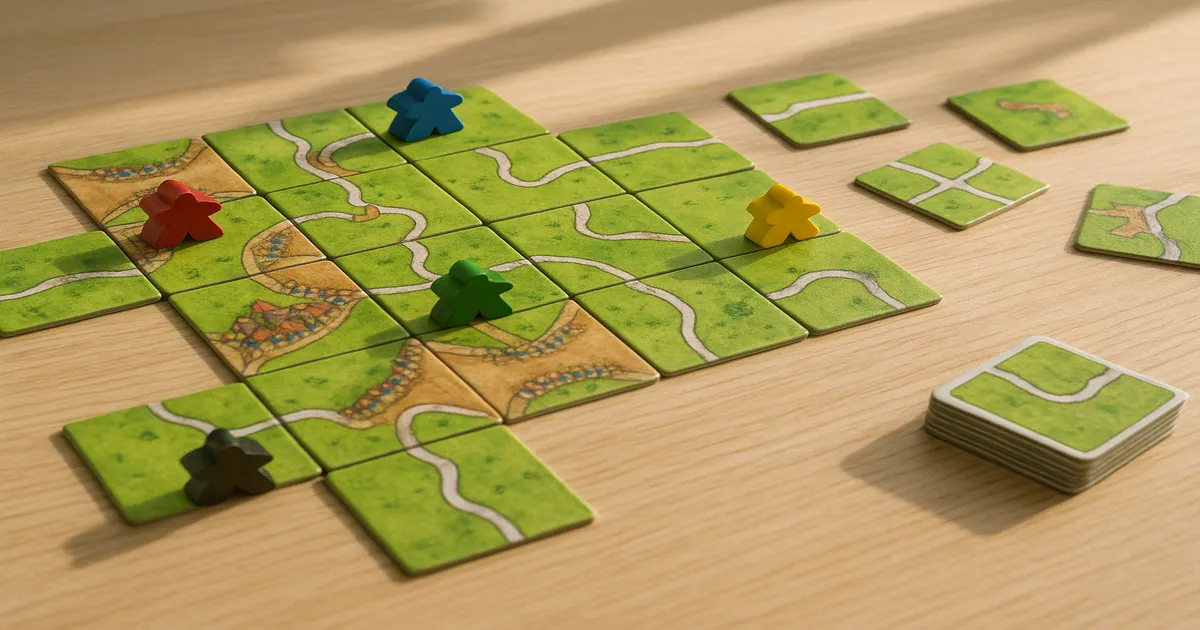
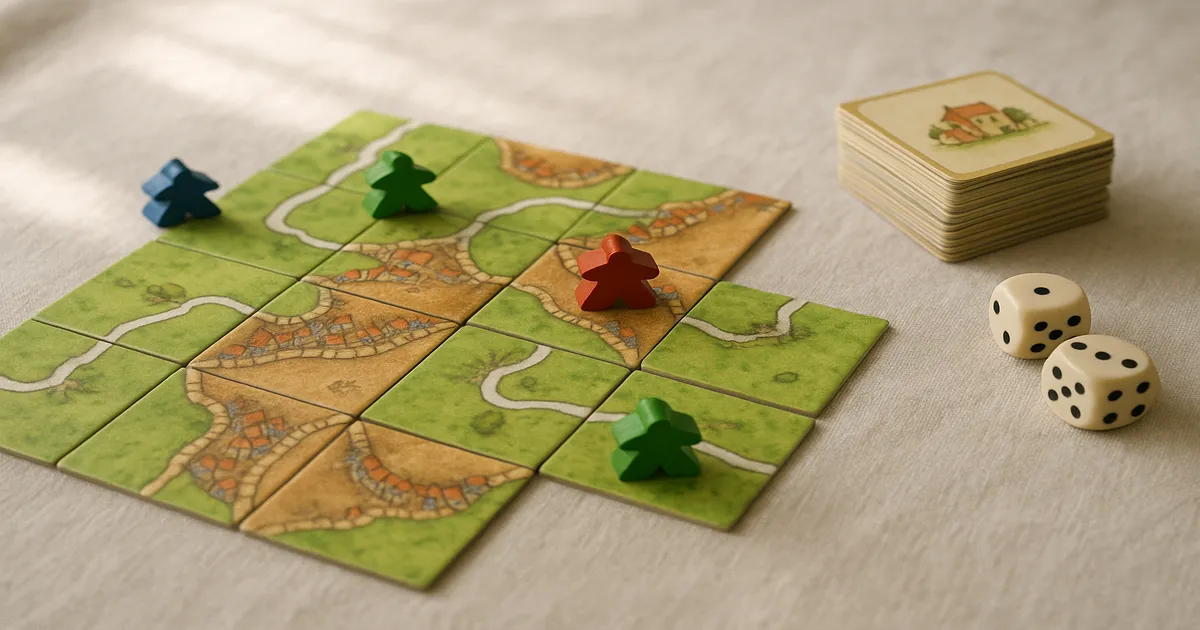
Quick Answer: Carcassonne: Inns & Cathedrals is the first and best expansion for the base game. It adds inn tiles that double road scoring (or wipe it to zero if the road never closes), cathedral tiles that boost city scoring (or wipe it to zero), and a big meeple that counts as two followers for majority control. Most experienced players consider it mandatory — they never play without it.
If you’ve played Carcassonne and felt like something was missing — a little more tension, a real reason to care about every road and city — learning how to play Carcassonne Inns and Cathedrals will fix that fast. This expansion doesn’t bloat the game. It sharpens it.
What Does Inns and Cathedrals Add to Carcassonne?
Three things come in the box that matter mechanically:
- Inn tiles — roads with a lake or boat symbol that double your points when completed, but score zero if left open at game end.
- Cathedral tiles — cities containing a cathedral that score 3 points per tile and 3 per pennant when finished (vs. the normal 2+2), but score nothing if the city never closes.
- The big meeple — one per player, counts as two followers for majority purposes. One piece, massive strategic weight.
Do You Need the Base Game?
Yes. Inns & Cathedrals is an expansion — no standalone rules, no standalone play. You need the base game’s tiles, meeples, and scoring track. That said, several Big Box editions bundle the base game with Inns & Cathedrals and a handful of other expansions. If you’re buying in fresh, that’s genuinely the best way to do it.
What’s in the Box?
The expansion includes 18 new land tiles printed on the same thick cardboard as the base game — they shuffle right in without any visual tells, which keeps the draw feeling natural. Some editions also include scoring tokens for tracking scores above 50, which happens more often than you’d expect once cathedral bonuses start landing.
Each of the five original player colors gets one large follower. It’s noticeably bigger than a standard meeple — you won’t mix them up on the table. The size difference isn’t cosmetic; it’s a constant visual reminder of how much that single piece can swing a game.
The expansion also includes a complete sixth-player set: standard meeples plus one big meeple in a new color. This is the only way to play Carcassonne with six people without buying anything extra, which makes Inns & Cathedrals quietly essential for larger groups.
One quick note on editions: the 2021 New Edition updated the art style across the entire Carcassonne line. Some longtime players prefer the original Doris Matthäus illustrations, but it’s purely aesthetic. Both editions are fully compatible — mix old and new tiles freely.
Inns and Cathedrals Rules: How the New Tiles Work
Inn Tiles
When a road contains an inn tile (identified by a small lake or boat symbol on the road segment itself), any follower with majority on that road scores 2 points per tile instead of 1 when it’s completed. The catch is brutal: if that road is never completed, it scores zero. Not reduced points. Zero. This is the rule people forget most often, and it causes the most table arguments.
Cathedral Tiles
A city containing a cathedral scores 3 points per tile plus 3 points per pennant when completed, instead of the normal 2 per tile and 2 per pennant. On a large city, that’s a significant swing. But an incomplete cathedral city at game end scores nothing — not the usual 1 point per tile, not the pennants. Zero. The risk is even more dramatic than inns because cities tend to involve more tiles and more meeples.
Spotting the Symbols
- Inns: A small lake with a boat or inn building, sitting on the road segment — not beside it.
- Cathedrals: A distinctive tower or church illustration within the city area.
Once you’ve seen them a few times, they’re unmistakable.
How the Big Meeple Works
The big meeple follows the same placement rules as a standard meeple — it goes on the tile you just drew and placed, not on an existing feature elsewhere on the board. It can go on a city, road, monastery, or farm, as long as that feature isn’t already connected to another follower.
For majority control, it counts as two followers. If an opponent has one standard meeple in a city and you join it with your big meeple, you win the majority and score all the points. Legitimate feature-stealing.
But here’s what trips people up: two opponent meeples tie your big meeple. It’s powerful, not magic. A player with two standard meeples in a feature matches you exactly — you’d both score full points. And like any meeple, it returns to you the moment the feature it’s on is scored. You only get one, so don’t burn it on something small in round three.
Turn Structure and Scoring with the Expansion
Turn Order
- Draw one tile from the shuffled stack (which now includes all 18 Inns & Cathedrals tiles).
- Place it legally — every edge must match its neighbors (city to city, road to road, field to field).
- Optionally place one follower — standard meeple or your big meeple — on the newly placed tile.
- Score any features completed by this placement, applying inn or cathedral bonuses where relevant.
- Return scored meeples to their owners.
End-Game Scoring: What Changes
At game end, the standard rules score incomplete features at reduced rates. Inns & Cathedrals overrides that in two specific cases:
- Incomplete inn roads: Score zero (normally 1 point per tile).
- Incomplete cathedral cities: Score zero (normally 1 point per tile plus 1 per pennant).
Everything else stays the same. Incomplete cities without cathedrals still score 1 per tile and 1 per pennant. Farms score 3 points per completed city they touch, with the majority farmer(s) taking the points. In a 6-player game, a contested farm can swing 50+ points — don’t ignore it.
Common Mistakes
Forgetting the zero-score penalty. Players reach end-game scoring, see an incomplete inn road, and instinctively score it at 1 per tile. Wrong. Inn road with no closure? Zero. Cathedral city left open? Zero. Write it on a sticky note if you have to.
Misusing the big meeple. Two mistakes come up constantly. First, players drop it on a modest feature in the opening turns, then spend the rest of the game wishing they had it back. Second, players assume it wins every majority fight — it doesn’t. Two standard meeples tie it. Also worth repeating: you cannot place it on an existing feature. It goes on your newly placed tile or it doesn’t go at all.
Standard Carcassonne errors the expansion amplifies. All edges of a tile must match, not just the one you’re actively connecting. You can’t join an existing feature that already has a follower, even if your tile looks isolated — check the connections. And scored meeples come back immediately; leaving them on the board compounds into a real problem.
Strategy Tips
If you’re new to the expansion, treat inns as a commitment, not a bonus. When you place a meeple on an inn road, make it your business to close that road. Don’t count on opponents to help — they have every incentive not to. Avoid cathedral cities early when they’re small and vulnerable. And save your big meeple for the mid-to-late game, when the board is crowded and majority battles actually matter.
At an intermediate level, the big meeple is as much a threat as a tool. Opponents who know you still have it will hesitate before joining your features, because they know you can break the tie. That hesitation has real value even when you never play the piece. Offensively, extending an opponent’s inn road without closing it is a nasty move — they’re committed to a road that may never score, and every tile you add deepens the problem.
For advanced players, the cathedral bait play is worth knowing: build a large, attractive cathedral city that pulls in opponents’ meeples, then quietly work to prevent its completion. Everyone in the city scores zero — but if you have fewer meeples committed than your opponents, you lose less. It requires patience and a decent read on the remaining tile distribution. Meeple counting matters too. A player with two or fewer meeples left can’t contest new features — open something valuable and watch them squirm.
At six players, farms are the game. A contested farm touching four or five completed cities can be worth 60+ points, and the big meeple counts as two farmers for majority. Getting it into a key farm early — before opponents can match it — is often the single highest-value play available. Don’t sleep on it.
How Inns and Cathedrals Compares to Other Expansions
Traders & Builders is the natural second expansion — it adds goods tokens that create a separate mini-competition and a builder follower that earns bonus turns. It’s excellent, but it adds more rules overhead than Inns & Cathedrals. Learn I&C first, then layer in Traders & Builders once your group is comfortable.
| Expansion | Complexity Added | What It Does | Worth It? |
|---|---|---|---|
| Inns & Cathedrals | Low–Medium | Risk/reward modifiers, big meeple, 6th player | ✅ Essential |
| Traders & Builders | Medium | Goods tokens, builder/pig followers | ✅ Great second pick |
| Princess & Dragon | Medium–High | Dragon destroys meeples | ⚠️ Divisive |
| The Tower | Medium | Capture opponents’ meeples | ⚠️ Aggressive |
| Abbey & Mayor | Medium–High | Mayor, barn, wagon followers | ✅ Good for veterans |
Princess & Dragon splits groups right down the middle. If your table hates having meeples eaten by a dragon, skip it entirely.
Similar Games Worth Knowing
If you love the tile-laying feel and want something nearby on the shelf:
- Kingdomino — Much simpler, plays faster, great for introducing non-gamers to tile-laying.
- Cascadia — Tile and token placement, Spiel des Jahres winner, beautiful production. 1–4 players, 30–45 minutes.
- Isle of Skye — Tile-laying with an auction mechanism, more strategic crunch. 2–5 players, 60–75 minutes.
- Ticket to Ride — Different mechanism but similar gateway appeal; often recommended alongside Carcassonne for new hobby gamers.
Frequently Asked Questions
What happens to an inn road that’s never completed?
It scores zero at game end — not the usual 1 point per tile. Any follower on that road returns to its owner, but no points are awarded. This overrides the normal end-game scoring for incomplete features, and it’s the rule new players miss most often.
Does the big meeple count as two meeples?
Yes, for majority control purposes. It can break ties or steal a feature from a single opponent meeple. But two standard meeples together match it exactly — both players score full points in a tie.
Can you play Inns and Cathedrals without the base game?
No. It’s an expansion and requires the Carcassonne base game to function. If you don’t own the base game, look for a Big Box edition that bundles both together.
Is Inns and Cathedrals compatible with the 2021 New Edition?
Fully compatible. The 2021 update changed the artwork but not the tile sizes, mechanics, or scoring. You can mix tiles from the original and new editions without any issues.
What’s the best first expansion for Carcassonne?
Inns & Cathedrals, and it’s not particularly close. It adds real strategic depth — the inn and cathedral risk/reward mechanics, the big meeple, 6-player support — without overwhelming anyone. Most experienced players consider it mandatory and never play the base game without it.