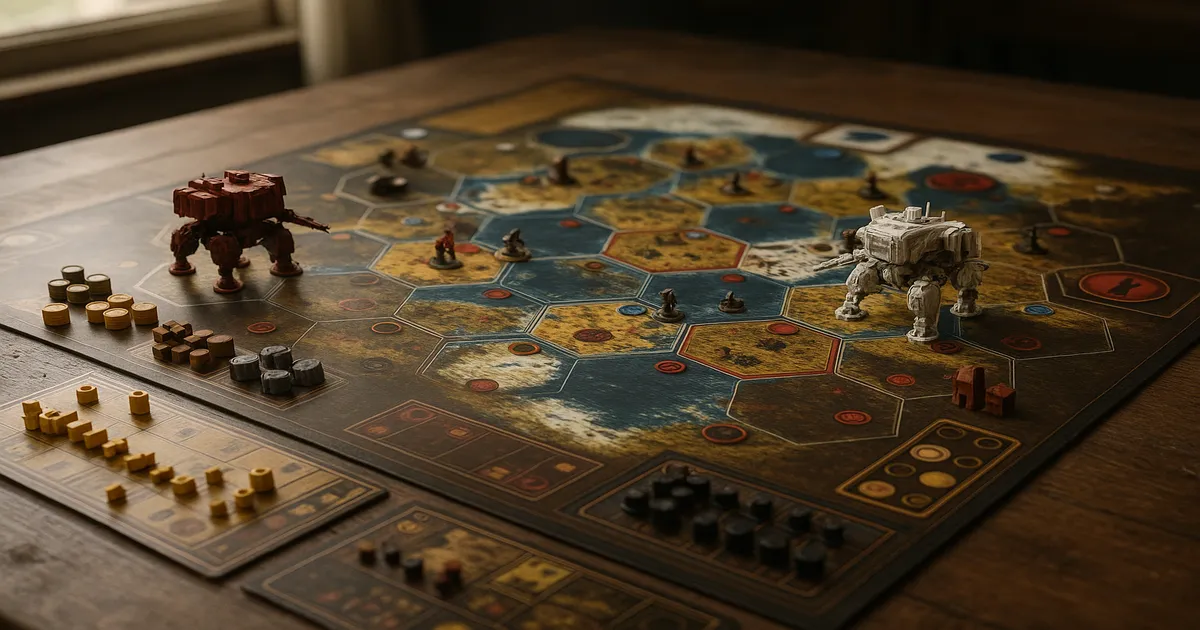
Quick Answer: Yes, you can play Scythe with 2 players — no special rules or variants required. It’s a legitimate, enjoyable experience, but it plays noticeably differently than a 4- or 5-player game: more strategic, less combative, and with more breathing room on the board. If the open-board feel sounds too passive, the Automa solo AI (included in the box) can add a third faction to create more pressure.
Scythe supports 1–5 players right out of the box, and the short answer to whether you can play Scythe with 2 players is: yes, and it works well. The more interesting question is how it plays — because 2-player Scythe is a genuinely different beast from what you’d experience at a full table. It’s slower to heat up, heavier on engine-building tension, and lighter on direct conflict. For the right pair of players, it’s one of the best two-player experiences in the medium-heavy weight class.
How Scythe Plays at 2 Players
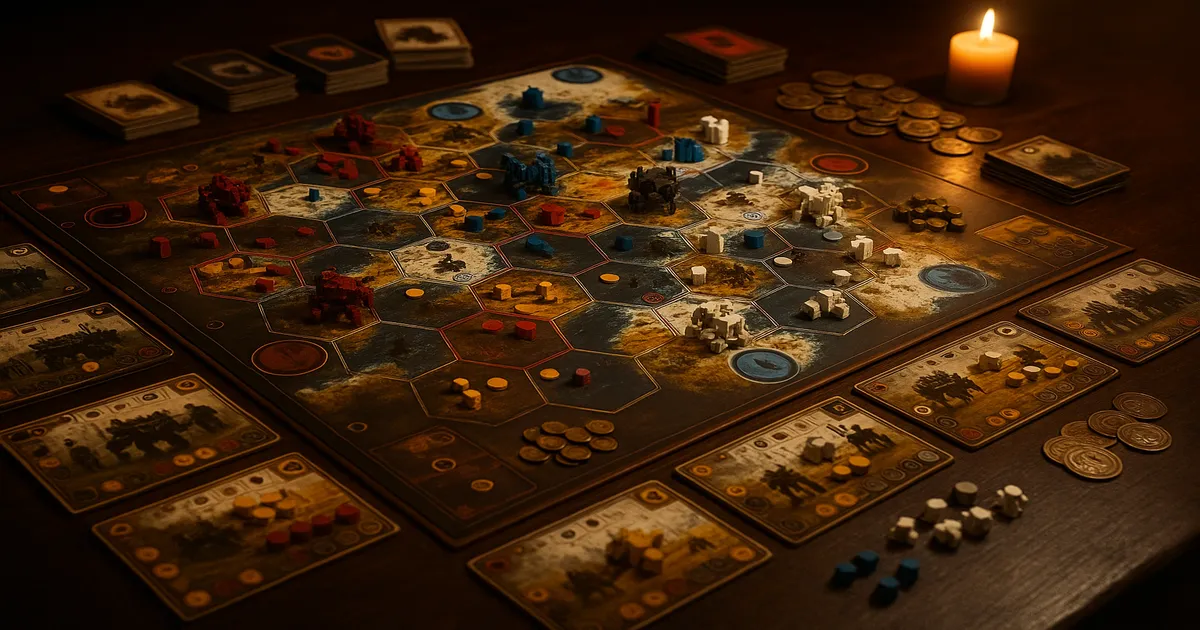
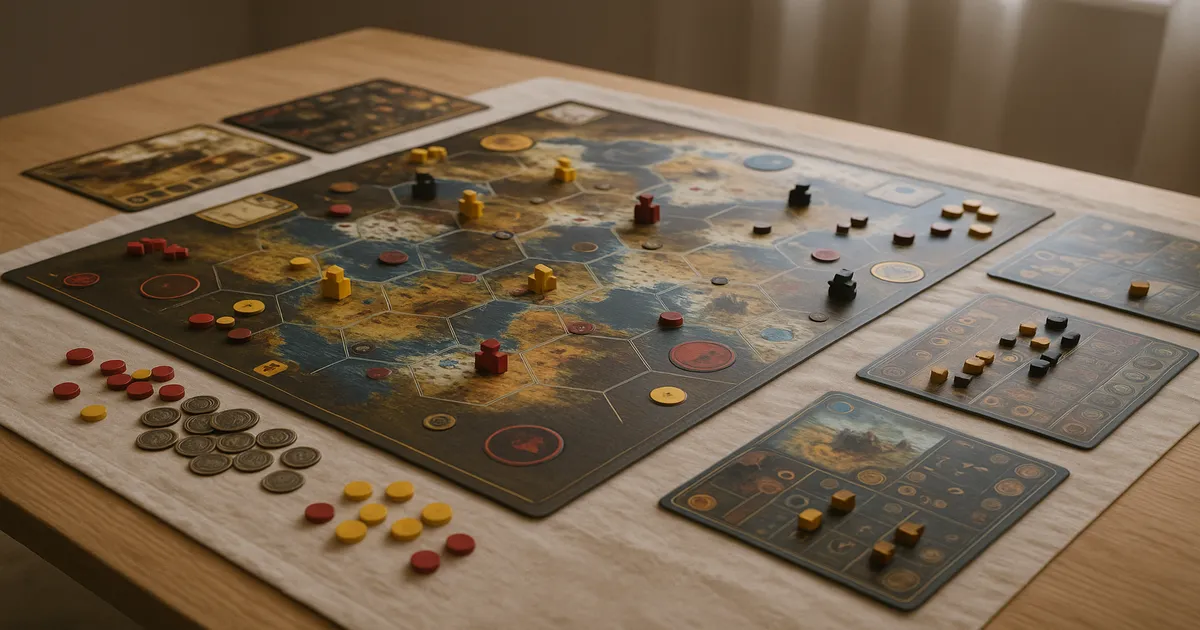
The Board Feels Wide Open
At 5 players, the map gets crowded fast. At 2, you can spend the first several turns expanding without ever brushing up against your opponent. Some people love this — it gives you space to actually execute your faction’s strategy without someone immediately stepping on your toes. Others find it slow and a bit lonely. Know which camp you’re in before you sit down.
Combat Becomes Optional, Not Inevitable
This is the biggest shift. At higher player counts, you’re going to get into fights whether you want to or not — someone’s always in your way. At 2 players, a fully passive “cold war” game is entirely viable. Both players can build their engines in relative peace and let final scoring decide the winner. That’s not necessarily bad, but it’s a very different feel from the tense mech standoffs the box art implies.
Faction Matchups Matter More
With only two factions on the board, asymmetric abilities have a larger relative impact. If one faction has a structural advantage over another in a specific matchup, there’s nowhere to hide — no third player to act as a buffer or disruptor. This makes faction selection (or random assignment) more consequential than it is at higher counts.
Recruit Bonuses Trigger Less Often
Recruits give you passive bonuses whenever an opponent takes certain bottom-row actions. At 5 players, those bonuses fire constantly. At 2, you’ve got one opponent, so they trigger roughly half as often. It’s not game-breaking, but it’s worth factoring in when you’re planning your engine — don’t build your whole strategy around recruit chains.
Game Length
Expect roughly 60–90 minutes once you know the rules. The game moves quickly because there’s less analysis paralysis and fewer turns before Stars start landing. For a medium-heavy euro, that’s a great runtime.
Scythe Gameplay Basics
The Rondel Action System
Each player has a personal player mat with four action pairs arranged in a grid. On your turn, you move your action pawn to any section you didn’t just use and take actions from that section. No hand of cards to manage, no dice to roll — just a clean push-pull of efficiency and opportunity cost.
Top Actions vs. Bottom Actions
Every section has a top action and a bottom action. Top actions (Move, Bolster, Produce, Trade) are cheap or free and generate resources or movement. Bottom actions (Deploy, Build, Enlist, Upgrade) cost resources but permanently improve your engine. You can take both on the same turn — and you should, as often as possible.
New players often only take the top action and wonder why their engine never gets going. Taking both actions on the same turn is the single most important habit to build early.
Combat: Blind Bidding, Not Dice
When your character or mech moves into a territory occupied by an opponent’s units, you can choose to fight. Both players secretly choose how much Power to spend and how many Combat Cards to play, then reveal simultaneously. Highest total wins; loser retreats. No dice, no randomness beyond the cards already in hand. Players who stockpile Power and Combat Cards going into a fight have a massive edge — preparation matters more than luck here.
How the Game Ends and Who Wins
The game ends immediately when any player places their 6th Star on the Triumph Track. Stars come from: combat victories (max 2), completing objectives (max 2), maxing Power, maxing Popularity, deploying all mechs, building all structures, enlisting all recruits, and fully upgrading.
Here’s what trips up most new players: the person who places their 6th Star does not automatically win. Final scoring is coins on hand plus a Popularity-based multiplier applied to Stars, territories, and resources. The Popularity tiers dramatically swing these multipliers — Tier 1 gives ×3/×2/×1, Tier 3 gives ×5/×4/×3. Ending the game first while your opponent has higher Popularity and more territories can absolutely cost you the win.
The Automa: Playing Scythe as ‘2.5 Players’
The Automa is Scythe’s solo AI system, and it ships in the base game. You run it from a dedicated card deck — each turn, flip a card and follow its instructions to move the Automa’s units, place Stars, and occupy territory. It’s designed for solo play, but plenty of 2-player groups use it as a third faction to add board pressure without adding a third player’s full complexity.
The Automa doesn’t score at the end. Its job is purely to occupy space, contest territories, and force both human players to react to something other than each other.
Should you use it? Try a few games without it first. If the open-board feel isn’t working for you — if it feels like you’re just racing to build engines in opposite corners — add the Automa. It’s a free fix that’s already in the box. Some pairs love the strategic space; others find it too quiet. You won’t know which you are until you’ve played a couple of games.
2-Player Scythe Strategy Tips
Identify your 6 Stars early. Experienced players know which Stars they’re targeting by turn three or four. Common reliable Stars: max Power, max Popularity, deploy all mechs, enlist all recruits. Pick six that align with your faction’s strengths and build toward them deliberately. Just doing whatever seems good each turn leads to inefficient games.
Don’t ignore the center of the board. At 2 players, it’s tempting to turtle in your home territory and expand slowly outward. Resist this. The Factory hex in the center grants access to a powerful Factory Card action that’s often worth the trip, and central territories count toward end-game scoring. Leaving them all to your opponent is a gift you can’t afford.
Watch your opponent’s Star count constantly. You have one opponent. If they’re sitting at 4 Stars and you’re at 2, you either need to accelerate hard or find a way to slow them down — and in Scythe, that usually means a well-timed combat. Don’t get so focused on your own engine that you miss the moment they’re about to end the game.
Respect the Popularity track. Crossing from Tier 2 into Tier 3 can mean 6–9 extra coins at game end depending on your Stars and territories. A single Encounter Card that pushes you over the threshold is often a bigger swing than winning a combat.
Fight selectively. Pure engine-building at 2 players can devolve into a “whoever has the better faction matchup wins” situation. Selective aggression keeps both players honest. Fight when you can earn a Star from it, when you can deny a critical territory, or when your opponent’s Power is low and you can win cheaply. Don’t fight just to fight — it costs Power and Combat Cards you may need later.
Faction and Player Mat Pairings for 2 Players
Rusviet is widely considered the strongest faction in the base game — the ability to use the same action section consecutively is a massive efficiency advantage. In competitive play, many groups ban or handicap Rusviet outright. For casual play, just be aware it’s not balanced against the other factions.
Saxony is particularly punishing at 2 players because its combat and objective Stars have no cap. Against a single opponent, Saxony can repeatedly bully you off territories and stack Stars from combat in a way that’s hard to counter.
Nordic’s river-crossing ability — normally a strong positional tool — is less impactful when board congestion is low. It’s not a weak faction, but its signature ability matters less when you’re not fighting over every hex.
On the player mat side, Mechanical and Agricultural are generally considered the strongest; Industrial the weakest. The gap isn’t enormous in casual play, though. Random pairing is the standard recommendation for balance, and it’s what most groups use.
If you want to be extra careful about balance, just agree upfront that Rusviet is off the table.
Common Mistakes in 2-Player Scythe
Thinking the game-ender automatically wins. This costs people games constantly. Read the scoring section above and internalize it before you play.
Only taking one action per turn. You can take both the top and bottom action in the same section on the same turn. Not doing this is the single biggest efficiency mistake new players make.
Neglecting Popularity. It’s not a nice-to-have — it’s a multiplier for everything. Ignoring it means your Stars and territories are worth dramatically less than your opponent’s.
Accidentally displacing enemy workers. If your character or mech moves into a territory with enemy workers, those workers retreat — and you lose 1 Popularity per displaced worker. New players trigger this accidentally and feel terrible about it. Know it’s coming.
Forgetting Recruit and Encounter triggers. Recruit bonuses are passive and easy to skip. Encounter Cards are mandatory when your character steps on an encounter hex for the first time. Both get forgotten regularly in early games.
Is 2-Player Scythe Worth It? Honest Verdict
If you enjoy meaty euro-style games with genuine strategic depth — building an efficient engine, managing multiple tracks, winning through positioning and planning rather than dice rolls — 2-player Scythe is excellent. It’s one of the best medium-heavy games at this count.
If you want frequent, tense combat and don’t enjoy long stretches of quiet engine-building, it might frustrate you. The cold-war dynamic is a feature for some players and a bug for others.
How 2-Player Scythe Compares to Root and Blood Rage
| Game | BGG Weight | Conflict Level | Play Time | Best For |
|---|---|---|---|---|
| Scythe | 3.42 | Low–Medium | 60–90 min | Engine building, strategic planning |
| Root | 3.72 | Medium–High | 60–90 min | Asymmetric rules, more direct conflict |
| Blood Rage | 2.87 | High | 60–90 min | Combat-focused, drafting, faster pace |
Root at 2 players has its own quirks — some factions play better at 2 than others — but it offers more direct conflict and interaction. Blood Rage is the pick if you just want to fight. Scythe is the pick if you want a deeper strategic puzzle.
One practical note: Scythe’s cards benefit from sleeving, especially if you’re playing frequently. (Dragon Shield Matte Standard sleeves) The Automa deck in particular gets shuffled constantly. And if you’re going deep on Scythe, the Invaders from Afar expansion adds two new factions (Albion and Togawa) that play well at 2 players and shake up the faction matchup meta considerably. A laser-cut insert or organizer is also worth considering if you own multiple expansions — the box gets unwieldy fast.
Frequently Asked Questions
Is Scythe good with 2 players?
Yes, genuinely. It plays differently than at 3–5 players — more open, less combative — but it’s a complete and satisfying experience. Players who enjoy engine-building and strategic planning tend to love it at 2. If you need constant conflict to stay engaged, it’s less ideal.
How long does a 2-player game of Scythe take?
Once you know the rules, expect 60–90 minutes. The game moves faster at 2 players because there’s less board congestion and fewer turns before Stars start landing. First games will run longer due to rules lookups and slower decision-making.
Do you need special rules to play Scythe with 2 players?
No. The base game fully supports 2 players with no variants or house rules required. Some groups optionally add the Automa as a third faction for more board pressure, but that’s a preference, not a fix.
What is the best faction for 2-player Scythe?
Rusviet is widely considered the strongest faction overall, and that holds at 2 players — possibly more so, since there’s no third or fourth player to check its efficiency. Many competitive groups ban it. For balanced casual play, random faction assignment is the way to go.
Should I buy Scythe expansions for 2-player games?
Invaders from Afar is the most useful first expansion for 2-player groups — it adds two new factions and costs less than the larger expansions. The Wind Gambit adds airships and new objectives, which adds variety but isn’t essential. Rise of Fenris is a campaign expansion best saved until you’ve played the base game extensively.